
Reviewed · MT FUJI TOURS
Mt fuji & Hakone customizable day tour w/ English speaking driver
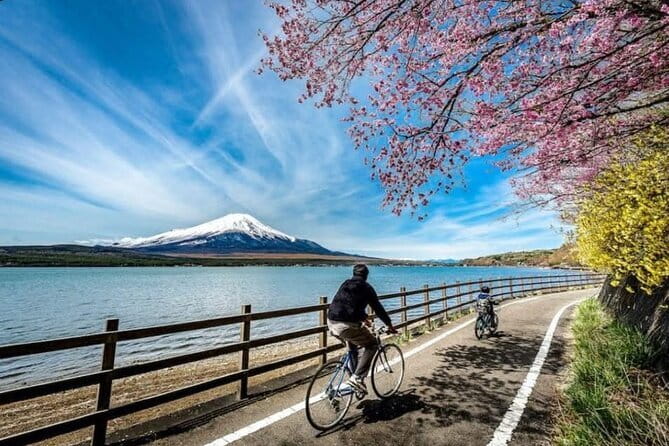
A day trip like this is interesting because it blends two of Japan’s biggest scenery hits, Mount Fuji and Hakone, but keeps the logistics calm with a private driver. You can shape the day around what you care about most, whether that is peak views, classic lakeside photo spots, or volcanic Hakone fun. One practical bonus from the real-world reviews: drivers like Adnan and Anique were noted for punctual pickup and for adjusting to senior travelers’ walking needs.
My favorite part is the private setup: hotel pickup, no ride-sharing stress, air-conditioned car, and an English and Japanese speaking driver-guide who can talk through what you’re seeing. I also like that the car comes with a WiFi hotspot, so you can check weather, navigate, and translate on the fly.
The main drawback to plan for is time and tickets. You get about 10 hours total, and most admissions are paid directly on the spot, plus some routes involve tolls (like the Subaru Line Fifth Station toll) that are not included. If weather is poor, the day can change, so you’ll want to be flexible.
Key things that make this tour work
- Private hotel pickup and English-speaking driver means less confusion, fewer transfers, and a calmer day.
- Route choice (6 presets plus customization) lets you avoid “we’ll see it all” fatigue.
- Big scenery checklist with Fuji viewpoints, lakeside stops, and a full Hakone stretch including Ōwakudani and Lake Ashi.
- Most attraction tickets are pay-on-arrival so you can match your day to real-time conditions.
- Driver-guides with long experience were praised in reviews for safety, timing, and making the day easier for seniors (including help from Ali and Anique).
- Clear-weather matters for Fuji, and the operator says poor weather triggers a reschedule or refund.
Private day trip: why the Fuji and Hakone combo is so efficient
If you try to do Mount Fuji and Hakone in one day on your own, the hardest part is not sightseeing. It is the moving pieces: trains, buses, timed transfers, and the constant fear of wasting daylight if you miss a connection. This kind of tour solves that by putting transportation, timing, and route decisions into one driver’s hands.
You also get the advantage of a driver who can respond to what you are actually seeing. On a clear day, it is all about holding the right stops for the right photo angles. On a hazy or rainy day, you may want to shift toward places that still feel worth it, like shrines, open-air sculpture spots, and lakeside walks.
This is not a “sit on a bus and hope for the best” day. It is a private experience up to 5 people, with meet-and-greet pickup and a modern vehicle. And in at least one review, the driver (Anique) went out of the way to keep seniors safe and comfortable, which tells me the best part of a private driver is not only convenience, it is adaptation.
More Mt Fuji days:
- Mt Fuji and Hakone 1-Day Bus Tour Return by Bullet Train
★ 5.0 · 26,383 reviews - Mt Fuji & Hakone Cruise, Drum Show Bullet Train 1 Day from Tokyo
★ 4.0 · 7,413 reviews - Tokyo Mt Fuji 5th St & Hakone Cruise Bus Tour w/Bullet Train
★ 4.4 · 5,024 reviews
The 10-hour timing reality from Tokyo (and why it matters)
The tour runs about 10 hours, with the note that only pick-up and drop-off time is included when pickup and drop-off are in Tokyo. Depending on how far you are from the Fuji area, the coordinators may shift timing for other locations.
Most versions start with pickup around 8:00 AM in Tokyo. The preset routes describe a typical return around 6:00 PM, and they mention drop-off windows like 3:00 to 4:00 PM if you start or end in the Fuji, Hakone, or Kanagawa region.
Here is the practical takeaway: those short stop times, often 30 to 45 minutes each, are there because travel time between Fuji and Hakone is real. If you want long walks or lots of shopping time, you should think of this as a highlight tour, not a slow wandering day.
Also plan for the “time gets tight” rule. After the 10 hours, any added time is billed as overtime at 5,000 JPY per hour, paid to the driver at the end. That is not unusual for private day trips, but it is something you should keep in mind so you do not lose control of your schedule late in the day.
Mount Fuji: choosing between 5th Station and the lakeside classics
Your Fuji side can go in a few directions depending on the route you pick or what you customize. The big decision is whether you want altitude and big sky views (the Mt. Fuji 5th Station) or a more relaxed photo circuit around ponds and lakes (Oshino Hakkai, Lake Kawaguchiko, Oishi Park, and Chureito Pagoda).
Mt. Fuji 5th Station: the high viewpoint option
The Mt. Fuji 5th Station sits around 2,300 meters and is known for panoramic views of mountains and forests. The stop is listed as 30 minutes, and admission is not included.
Two things to remember. First, “amazing” here depends heavily on weather. You are higher up, and visibility can change quickly. Second, the tour notes that toll fees at the Subaru Line Fifth Station are not included, ranging from 2,100 JPY to 3,460 JPY per vehicle, paid at the toll gate.
If your goal is a classic Fuji “wow” moment, this is the stop. If your goal is more Fuji photography without altitude stress, you may prefer to keep your day at lakeside and lower points.
A change of pace from Tokyo:
- 1-Day Tokyo Bus Tour
★ 5.0 · 14,250 reviews - Tokyo: TOKYO SKYTREE® Admission ticket
★ 4.5 · 11,192 reviews - Tokyo: teamLab Planets TOKYO Digital Art Museum Entry Ticket
★ 4.6 · 9,779 reviews - Tokyo: Sumo Show Experience with Chicken Hot Pot and a Photo
★ 4.8 · 6,678 reviews
Oshino Hakkai: Fuji snowmelt in neat pond form
Oshino Hakkai is built around eight spring ponds fed by melted snow from Mount Fuji. The cultural setting includes traditional thatched-roof houses, and the stop is 30 minutes with admission not included.
This is a good choice when Fuji is visible but you do not want the altitude factor. It is also a nice break in pacing between more demanding viewpoint stops.
Chureito Pagoda: the iconic Fuji backdrop
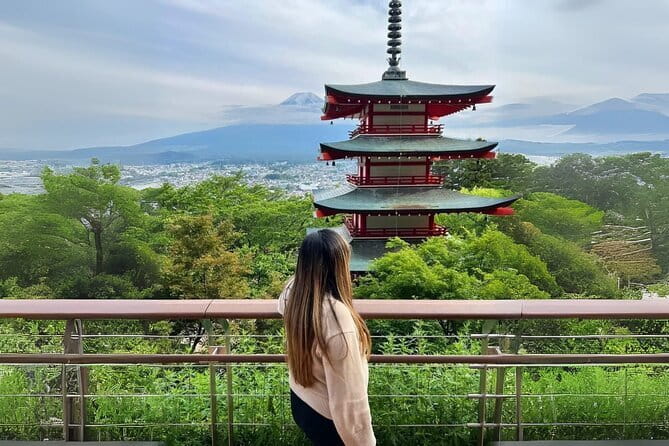
Chureito Pagoda is one of those places where the scenery is the whole reason you go. It is listed as a 45-minute stop with admission included. The view is especially famous in spring and winter, but even outside peak seasons, it is a classic composition: a hillside pagoda angle framed by Mount Fuji.
The catch is crowd and timing. Because the stop is set, you cannot treat it like a lingering street market. If you are chasing the “perfect shot,” this tour structure still works, but you will want to move fast and pick your vantage point early.
Lake Kawaguchiko and Oishi Park: where the reflections happen
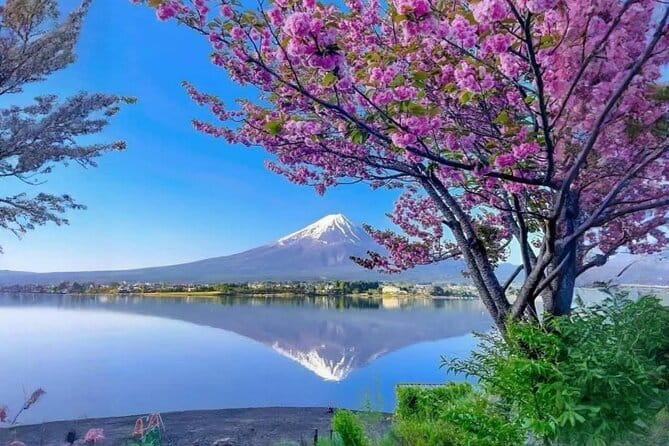
If Mount Fuji is the main event, Lake Kawaguchiko is often where the mountain turns into a mirror. The tour lists a 30-minute stop at Lake Kawaguchiko with admission included, and another 30-minute stop at Oishi Park also with admission included.
Oishi Park is known for Fuji views framed by seasonal flowers. The tour notes special fame for its lavender fields, so it is a great pick when the timing matches the season.
Practical note: reflections depend on conditions. A calm day makes the lake feel magical. Wind or rain reduces the “mirror” effect, but even then the area is still a strong viewpoint and a break from viewpoint-to-viewpoint driving.
The Hakone transition: Ōwakudani to Lake Ashi in one smooth arc
Once you cross into Hakone, you are trading pure “Fuji sightseeing” for geothermal drama and lakeside calm. The tour generally includes multiple Hakone icons, so you get variety without needing to plan transfers yourself.
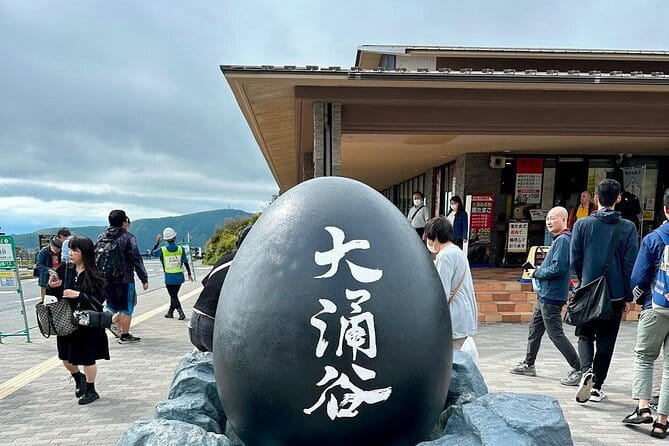
Ōwakudani Valley: steam, sulfur vents, and volcanic terrain
Ōwakudani Valley is a volcanic wonder where you can see steaming hot springs and sulfur vents. The stop is 30 minutes, with admission not included.
This is one of those spots where a short visit is enough to feel the uniqueness. You also get a strong reminder that Japan’s volcano energy is not a museum concept. It is right there.
Hakone Open-Air Museum: art with a mountain backdrop
The Hakone Open-Air Museum combines sculptures and nature, and the tour allots 40 minutes, with admission not included.
In a day like this, the museum does not replace a full half-day at Hakone, but it is a smart inclusion. Even if you are not an art fanatic, it helps break up the day so you are not doing only views and hot spots.
Hakone Ropeway and the Hakone Shrine torii
The tour lists Hakone Ropeway as a 45-minute stop with admission not included, and Hakone Jinja as a 40-minute stop with admission not included.
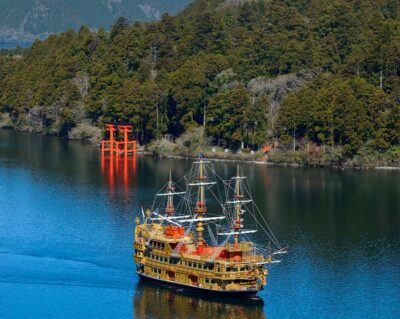
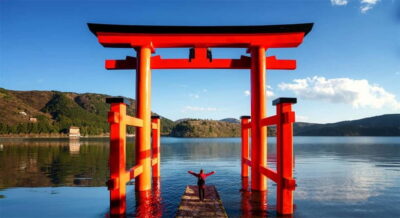
Hakone Jinja is famous for the red torii gate in Lake Ashi waters. That image is basically a postcard legend for Hakone, and having it on a private schedule helps you aim for better visibility. Ropeway rides also give you aerial perspective over the area, but again, fog and rain can reduce how much you see.
Lake Ashinoko: the crater lake view and cruise potential
Lake Ashinoko, also called Lake Ashi, is listed as 45 minutes with admission included. The description notes it is known for scenic boat cruises where you can enjoy tranquil lake views and, on clear days, views of Mount Fuji.
One of the preset options specifically mentions a pirate ship cruise from Togendai to Motohakone. If your route includes that, you should treat it as one of the day’s “slow moments,” when you stop moving and let the scenery do the talking.
Ropeways and other high-view options: keep your eyes on visibility

This tour includes at least one aerial viewpoint option in the Fuji region too, such as the Mt. Fuji Panoramic Ropeway (listed at 1 hour with admission not included). You might see similar ropeway options depending on the preset route you choose, like Kachi Kachi Ropeway.
The rule of thumb: ropeways are worth it when skies are clear. When the visibility is poor, a ropeway still gives you variety, but you should expect fewer “big take-your-breath-away” vistas.
Gotemba Premium Outlets: shopping with a Fuji backdrop

Not everyone wants more temples and scenic stops, and that is where Gotemba Premium Outlets can fit. One preset route lists a 2-hour stop here, with admission included.
The key point is that Gotemba is not only a place to shop. It is also a viewpoint area where you might get Mount Fuji views while you browse. If your group has mixed interests, this stop can prevent the common problem of one person pushing hard for another shrine while everyone else is tired.
English-speaking driver value: what the names in reviews say
A lot of private tours sell the same thing: “English speaking driver.” This one clearly delivers that, but what matters is how they use the language. You can ask, get quick answers, and understand what you are looking at without guessing.
The tour notes the driver is a licensed guide with around 26 years of driving experience in Japan. That helps with safety and pacing, and it likely reduces stress at busy intersections around attractions.
The reviews add color. People praised drivers for being punctual and safe, and Anique was specifically mentioned for helping seniors with walking difficulties. Another reviewer highlighted Ali as helpful, and another mentioned Adnan for friendly, professional communication. Those are small details, but they often predict how smooth your day feels, especially when your route includes multiple stepping points in a single day.
Price and value: where $530 per group fits best
At $530 per group up to 5, the math depends on how you would otherwise travel. If you are thinking about hiring a private car plus dealing with train transfers, this starts to look reasonable fast.
What you are paying for here is not just a ride. It is:
- hotel pickup and drop-off
- an English and Japanese speaking driver-guide
- highway toll coverage
- WiFi hotspot in the car
- a modern, clean, air-conditioned vehicle
What you are not paying for: most attraction admissions, food, and several specific items like the Subaru Line toll at the Fifth Station.
So the value question becomes: do you have more than one person, or do you want a private day without the stress of navigating? If yes, this can be a good use of time, and it can feel like you bought yourself a smoother day rather than just a cheaper taxi.
If you are traveling solo or with just one person, you might still like the convenience. But you should compare it against a cheaper public transit plan, especially on days when you can ride the networks easily.
What to do before you go: clear Fuji day survival tips
This tour explicitly notes that good weather is required for the adventure. If weather forces changes, you may be given a new date or a complete refund.
Based on real-world tips from the reviews, I’d show up prepared like this:
- Bring cash for places where you pay on the spot.
- Bring a handheld fan and an umbrella. The weather swings in Japan can be quick.
- Bring bottled water, because a busy day adds up.
- Double-check visibility expectations when it comes to the Fuji viewpoints and the ropeways.
Also remember: the tour expects you to pay attraction tickets directly on the spot. That is not complicated, but you should not plan on every ticket being handled in advance.
Routes and customization: how to pick the day that fits your group
The tour offers six preset routes plus the option to customize your itinerary. That matters because Fuji and Hakone days are personal. Some people want lakes and photo stops. Others want volcanic Hakone and a boat cruise. And some want a shopping break.
Here is the spirit of each preset, in plain terms:
- Route 1 leans Fuji region with Oshino Hakkai, Chureito Pagoda plus Arakurayama Shrine, then Lake Kawaguchiko, a ropeway stop, Lake Saiko, and Iyashi no Sato.
- Route 2 mixes Fuji or Hakone views with Gotemba Premium Outlets.
- Route 3 centers Mt. Fuji 5th Station, then Oshino Hakkai and the Chureito area, finishing around Lake Kawaguchiko with a ropeway option.
- Route 4 is similar to Route 3 in the Fuji high stops, then adds Gotemba Premium Outlets.
- Route 5 is a classic Fuji-to-Hakone blend: 5th Station, a Kawaguchiko pass-by for photos, then Ōwakudani, Lake Ashi, and Hakone Shrine.
- Route 6 is more Hakone-forward: Ōwakudani, Hakone Ropeway, Hakone Open-Air Museum, Lake Ashi with a cruise mention, then Hakone Shrine.
If you want one clear rule for choosing, it is this: decide whether your group cares more about altitude and summit views (5th Station) or lakeside reflections plus iconic photo angles (Kawaguchiko, Oishi Park, Chureito). Then build your rest of the day around that.
Should you book this private Fuji and Hakone day trip?
Book it if you want a private, time-smart day that still hits the big names in Fuji and Hakone. It is especially good for mixed-interest groups, families who hate transfers, and anyone who wants the help of an English-speaking driver-guide to keep you moving without stress.
Skip it or adjust expectations if your group is very sensitive to weather, or if you want long unhurried stays at a single location. This is a highlights-focused schedule built on short stops plus driving, not a slow travel day.
My practical final advice: if you book, think about your “must-have” view first, either Mt. Fuji 5th Station or the Kawaguchiko plus Chureito photo circuit. Then pick the preset route or customize so the rest of the day supports that core goal. That is how you get the best return from the 10-hour clock.
FAQ
How many people can be in this private tour?
The tour is private, and the group size is up to 5 people.
What is the total duration of the tour?
The tour lasts about 10 hours.
Is hotel pickup included?
Yes. Hotel pickup is offered for convenience.
Does the driver speak English?
Yes. The guide/driver speaks English and Japanese.
Are attraction tickets included in the price?
Most admission fees are not included. You pay for tickets directly on the spot. Some stops in the itinerary are listed as admission included, like Lake Kawaguchiko and Oishi Park, but many others are explicitly not included.
Is WiFi available during the drive?
Yes. A WiFi hotspot router is provided in the car.
Do you need to pay tolls separately?
Yes for at least one case. The tour notes that the toll fee at Subaru Line Fifth Station is not included and needs to be paid at the toll gate, ranging from 2,100 JPY to 3,460 JPY per vehicle.
What happens if the weather is bad for Mount Fuji viewing?
The tour states that good weather is required. If unavoidable circumstances or bad weather occurs, you will be given a new date or a complete refund.
Can you cancel for a full refund?
Yes. Free cancellation is available up to 24 hours in advance of the experience start time for a full refund.
Is there a limit on child seats?
Only one child seat per group or vehicle may be provided by the operator.
Latest write-ups near Tokyo
- Tokyo Nights: Shibuya Photo Adventure★ 5.0 · 20 reviews
- Wagyu & Sake 8 Course Tasting Dinner in Shinjuku★ 4.9 · 20 reviews
- Making Japanese desserts Nerikiri & drinking matcha in Tokyo★ 5.0 · 20 reviews
- Japanese Whisky Hunting《HIGH-QUALITY-ONLY》Rare Tasting Class★ 5.0 · 20 reviews
- Mt. Fuji 5th Station, Owakudani Ropeway, Pirate Ship plus Outlet shopping!★ 4.5 · 20 reviews
- Kintsugi Experience with Arita Ware in Tokyo (English Guide)★ 4.8 · 20 reviews
- This is Asakusa! A Tour Includes the All Must-Sees!★ 5.0 · 20 reviews
- Tokyo: Karate Experience with Former All-Japan Champion★ 5.0 · 20 reviews
Mt Fuji Tours, compared.
Mt Fuji and Hakone 1-Day Bus Tour Return by Bullet Train
Read our review →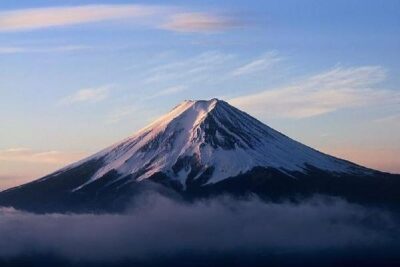
Mt Fuji & Hakone Cruise, Drum Show Bullet Train 1 Day from Tokyo
Read our review →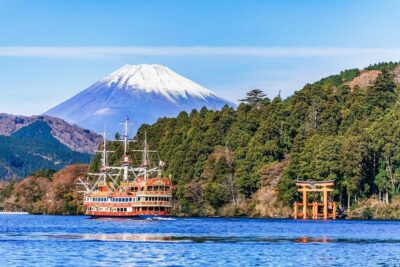
Tokyo Mt Fuji 5th St & Hakone Cruise Bus Tour w/Bullet Train
Read our review →
Mt. Fuji Tour, Hakone Ropeway, Owakudani, Lake Ashi
Read our review →
Mt.Fuji,Kawaguchiko Oishi Park,Arakurayama Sengen Park
Read our review →
Mt. Fuji 5th Station & Hakone Cruise 1-Day Bus Tour
Read our review →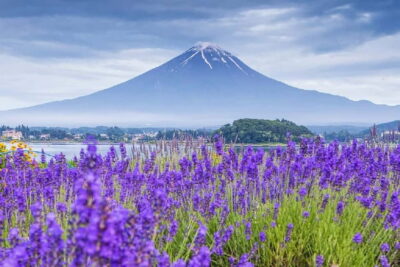
Mt Fuji Top 5 Spots Day Tour: Arakurayama Park,Oshino Hakkai
Read our review →Browse the lists this tour appears in