
Reviewed · WALKING TOURS
Takayama: Takayama Jinya & Old Town Private Walking Tour
Takayama Jinya and Old Town is interesting because you get to walk through a surviving Edo-period government site, then pivot into the streets people actually shop, eat, and drink in today. I love how the tour makes the formal world of the Jinya feel practical, with clear explanations of how the place worked. I also love the second half, where Sanmachi Suji turns into a photo-friendly stroll with chances to pick up real local goods, then you finish with a sake tasting. One possible drawback: you’ll likely remove your shoes inside Takayama Jinya, and if it is cold or wet out, the tatami floors can feel chilly, so bring warmer socks.
The guides are a big part of the value. I’ve seen names like Akane, Yuko, Micah, Mihoko, Toshi-san, and William show up in recent bookings, and the common thread is how calmly and clearly they explain what you’re looking at, plus how they share extra local pointers once you’re done.
Plan for a relaxed pace and 2 hours of walking. This is not a sprint tour, so it fits well if you want to look closely at architecture, browse small shops, and sip sake without feeling rushed.
Key points before you go
- Takayama Jinya first: start at the Edo-era government building so the old town makes more sense right away
- Sanmachi Suji on foot: traditional wooden streets with built-in photo stops
- Sake tasting at a historic brewery: a guided session, not just a random stop
- Hands-on cultural details: shoes off inside, and you carry them in a plastic bag
- Small-shop shopping time: miso, handcrafted items, and fragrances along the route
- Private group flexibility: your guide can slow down for questions and recommendations
Takayama Jinya, the Edo-era government building you can actually walk through
Your tour begins at 高山陣屋 (Takayama Jinya), with the guide meeting you at the reception desk near the main gate. This matters because the Jinya is not just a pretty building. It is the last remaining government building of its kind from the Edo period, so it helps you understand why Takayama looked the way it did and how authority worked here.
When you step inside, you’ll follow the site rules. Expect to remove your shoes, and you’ll carry them in a plastic bag. That sounds like a small detail until you’re standing on tatami. One review mentioned the day being cold and wet, with tatami floors feeling cold, and the practical takeaway is simple: wear layers and consider warmer socks if the weather is miserable.
The guided portion is where this stop earns its keep. You’re not only touring rooms, you’re getting context. One guide’s explanations included how government functions tied to things like justice administration and tax collection. That kind of framing turns the building into a real place where people worked, made decisions, and followed procedures, not just a snapshot from the past.
You’ll also get a photo stop and guided walk time during the Jinya segment, with about an hour allocated to this first leg. If you like history but hate standing in silence, this style works well because you get answers as you go, right where the details are.
More Walking Tours in Takayama:
- Takayama Old Town Walking Tour with Local Guide
★ 4.5 · 50 reviews - Explore Kiso Valley : Magome – Tsumago Mountain Trail Walk
★ 5.0 · 33 reviews - Takayama: Private Walking Tour with a Local Guide
★ 4.6 · 29 reviews
Sanmachi Suji: where the old town becomes a practical walking route
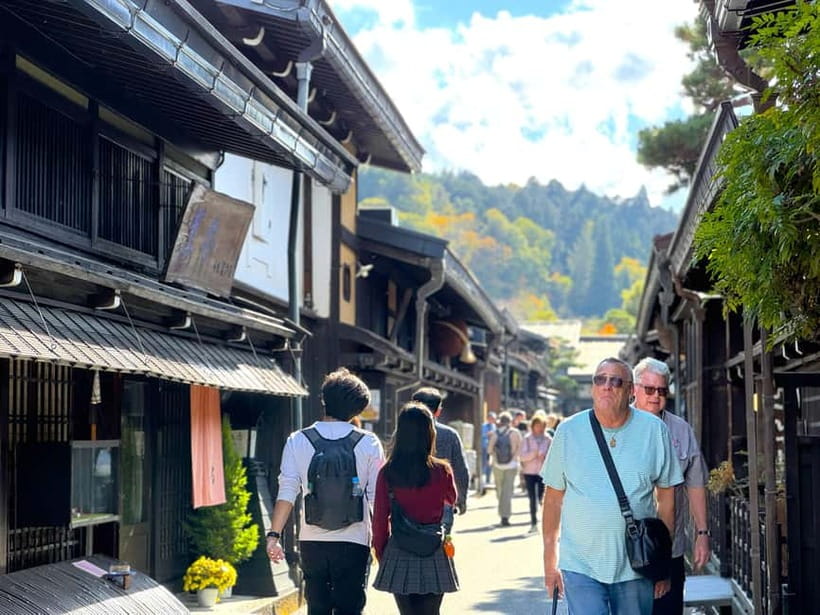
After the Jinya, the tour moves into Sanmachi Suji, Takayama’s old-town core. This is the part most people picture: atmospheric streets lined with older wooden buildings. The guide leads you along, and you get another photo stop so you can frame the streetscape instead of just guessing where the best views are.
Here is why I like this sequence so much. Starting with Takayama Jinya gives you context, then Sanmachi Suji lets you translate that context into daily life. You go from a place of administration to a street where craftsmen and traders would have mattered in everyday routines.
Yes, today many of the buildings are shops and restaurants. If you’re hoping for empty, museum-quiet streets, lower-season timing helps, but even then, this is still a living neighborhood. The payoff is that you’re walking through a place where you can buy things made locally, not just look at them.
On this part of the tour, you’ll also get time to browse local storefronts for handcrafted goods, miso, and fragrances. You can treat it like a “smart stroll,” where your guide can point out what is truly local versus generic souvenirs. And if the weather is bad, you still have reasons to keep moving because the shopping stops keep you from feeling stuck.
One review also noted that independent sake breweries can be part of what you pass nearby, and that helps explain why the tour ends with sake. It is the same story continuing, just in a different form.
The sake tasting at a historic brewery: small lesson, good payoff
A big selling point is the stop for a sake-tasting session at a historic brewery. This is included, and for a 2-hour tour, that inclusion is a big value driver. A tasting like this is not just a nice extra. It turns the town into something you can taste, and it gives your guide a chance to talk about how sake fits into local culture and production traditions.
You should expect a guided experience, since the tour includes the tasting as part of the activity. One review specifically wished the tasting was more guided, with more explanation during sampling. That is useful to know, because it suggests the main value is the tasting plus whatever context your guide offers, but you might want to ask questions during the session if you want deeper details about what you are tasting.
Practically, pace it. You have been walking. You are going to want to sip, not chug. If you plan to eat later, it helps to know how strongly the sake is flavored so you don’t show up hungry at your next meal and then accidentally turn your taste buds into mush.
Also, the tour seems designed to avoid turning you into a sake expert. It is more like sampling with context, paired with old-town strolling and browsing.
Price and value: why $68 for 2 hours can make sense here
At $68 per person for a private 2-hour tour, this is not the cheapest way to see Takayama. But it can be good value because the price covers more than “a guide leading you around.”
Included are:
- Admission fee to Takayama Jinya
- Sake tasting session
- Guided walking tour
If you try to self-tour, you still have to pay for entry into the Jinya and figure out where to do a tasting that feels legit and not random. When you combine the admission plus a structured tasting plus a local guide, the $68 starts to look like you are paying for friction-free planning and better context.
One note: transportation to and from the meeting point is not included. This is normal for walking tours, but it affects your real cost. If you are far from Takayama Jinya, add transit time and whatever fare applies to you.
This is also a private group. That matters if you’re traveling with someone you trust to keep your pace. In a private format, the guide can adjust for your interests, whether that is architecture photos, shop browsing, or more questions about how the Jinya operated.
A change of pace from Takayama:
- Kanazawa: World Heritage Shirakawa-go Morning Guided Tour
★ 4.9 · 988 reviews - Kanazawa: World Heritage Shirakawa-go & Two Local Experience
★ 4.9 · 274 reviews - Kanazawa/Takayama: Shirakawago & Takayama Private Day Tour
★ 4.8 · 172 reviews - Departing from Takayama [Regular sightseeing bus] World Heritage Sites Shirakawago and Gokayama Ainokura
★ 4.5 · 137 reviews
What the 2-hour flow feels like on the ground
The tour has a tidy structure:
- Takayama Jinya for about an hour, including photo stop and guided visit
- Sanmachi Suji for about an hour, with photo stops and shop browsing along the way
- It finishes in the old-town area around 古い町並 (Furui Machinami, Old Town)
That pacing is part of the appeal. You are not dragged through a 6-hour itinerary. You get enough time to see the main old-town sights without burning the whole day, which is great if you have other plans in Takayama such as food stops, a morning market, or additional museums.
The most consistent praise tied to the guides is how they manage the pace. I saw multiple comments about tours feeling not rushed and well paced. That is what you want from a private walking experience. If the guide is thoughtful with timing, you can actually enjoy the details you came for.
Also, because the route is mostly walking, comfort matters. Wear shoes you can walk in for the full two hours, then be ready to switch into shoe-off mode inside the Jinya.
Who this tour fits best, and who might want a different option
This tour is a strong match if you like:
- Old wooden streets and photo stops you can count on
- Context, not just locations
- A short, guided plan that includes a tasting
- Small-shop browsing for things like miso and fragrances
It also works well if you’re the type who asks questions. Several guides named in recent bookings, including Mihoko and Yuko, were described as patient and respectful of questions. That is a big deal when you want explanations you can actually use while you’re standing in front of the building.
Who might not love it? If you want a long, slow, deeply academic history lecture, the 2-hour format may feel too compact. And if you are chasing a very detailed breakdown of every sake difference, you may want to ask more during the tasting, since one comment suggested the tasting could include more guided explanation.
Practical tips so your tour is smoother
A few small things can make the day feel better.
- Bring warmer socks if it is cold or rainy. Tatami floors can be chilly, especially on wet days.
- Plan for shoe removal inside Takayama Jinya. You will carry your shoes in a plastic bag, so keep your bag situation simple.
- Have one small plan for after the tour. You will finish around Old Town, and your guide often shares meal ideas and other activities.
- Ask questions during the tasting. If you want more sake education, this is where you can get it.
Should you book Takayama Jinya and Old Town Private Walking Tour?
I’d book this tour if you want a compact, high-impact way to connect two sides of Takayama: the Edo-era government world inside Takayama Jinya and the everyday old-town street life along Sanmachi Suji. The added sake tasting at a historic brewery is a smart inclusion, and the private format helps you move at a comfortable pace.
I’d skip it if you already know Takayama well and you’re trying to minimize cost, since $68 plus admission and a tasting is still a premium over self-guided strolling. Also, if you hate any chance of being shoe-off at a site, know that this stop includes it, and plan for it.
If you want a guided old town experience that mixes history, walking, shopping time, and sake, this one is built for that exact goal.
Latest write-ups near Takayama
- Ninja Experience in Takayama – Trial Course★ 5.0 · 20 reviews
- Magome & Tsumago Nakasendo Full-Day Private Trip with Government-Licensed Guide★ 5.0 · 20 reviews
- Ninja experience in Takayama – Special Course★ 5.0 · 20 reviews
- Frozen fall trekking★ 5.0 · 21 reviews
- Takayama: Edo-Period Old Town Walking Tour★ 4.5 · 22 reviews
- 1-Day Tour from Takayama: Hida Folk Village, Caves & Ropeway★ 5.0 · 24 reviews
- Takayama: Private Walking Tour with a Local Guide★ 4.6 · 29 reviews
- Sawanobori River Trekking Tour★ 5.0 · 30 reviews
Walking Tours, compared.
Kyoto Geisha Walking Tour: Gion District & Hidden Gems
Read our review →
Tokyo Tsukiji Fish Market Food and Culture Walking Tour
Read our review →
Gion Magical Night Walking Tour with Geisha Trivia
Read our review →
Imperial Palace and Shogun Historical Walking Tour
Read our review →
Gion Geisha District Walking Tour – Stories of Geisha
Read our review →
Shinjuku Local Bar and Izakaya Guided Walking Tour
Read our review →
Browse the lists this tour appears in