
Reviewed · GEISHA & GION TOURS
One Hour Geisha Show in Kyoto
If you want Kyoto culture in real time, this Maiko show is interesting because the performance is short, personal, and meant to be seen up close. I especially like that you meet an actual Maiko apprentice, not just watch a staged act. I also like that you get structured Q&A, plus time to play a traditional game and take photos and videos. One possible drawback: the Maiko will not be performing continuously for the full hour, since the art is intentionally brief and paced.
You also get to choose how the evening feels, with two different venues. The Tea House option includes a shrine visit, while the Gion Theater option is set in a showhouse. Before you go, plan on following a few simple rules, like wearing socks and keeping strollers away.
Key points that make this experience worth your time
- Meet a real Maiko and watch her perform close enough to appreciate the details
- Photos and videos are welcome, and you also get a photo moment afterward
- Q&A is part of the show, so you are not just passively watching
- Short performances by design, so the timing feels respectful, not dragged out
- Optional Kitano Tenmangū shrine time with the Maiko on the Tea House option
Why a one-hour Maiko show feels special in Kyoto
This is the kind of Kyoto experience that works because it is not trying to turn tradition into a long spectacle. The show is built around a real Maiko, with performances kept intentionally short to preserve the grace and exclusivity of the art. That matters, because you get the feeling that you are witnessing something meant to be held back, not mass produced for tourists.
One helpful detail: the tour runs about 1 hour to 105 minutes, but you should not expect the Maiko to be dancing nonstop the entire time. You will see brief dance segments, then shift into Q&A, photos, and a chance to interact through a game. For me, that mix is what makes the time feel worth it, especially if you like your travel experiences to include conversation and context, not just visuals.
More Geisha Experiences in Kyoto:
- Kyoto Geisha Walking Tour: Gion District & Hidden Gems
★ 4.7 · 3,273 reviews - Kyoto: Gion Magical Night Walking Tour with Geisha Trivia
★ 4.9 · 2,393 reviews - Kyoto: Gion Geisha District Walking Tour – Stories of Geisha
★ 4.7 · 2,187 reviews
Pick the right venue: Tea House in a Kyo-machi-ya or Gion Theater showhouse
You have two different ways to do this show, and choosing the right one can change the day.
Tea House option (with a shrine visit)
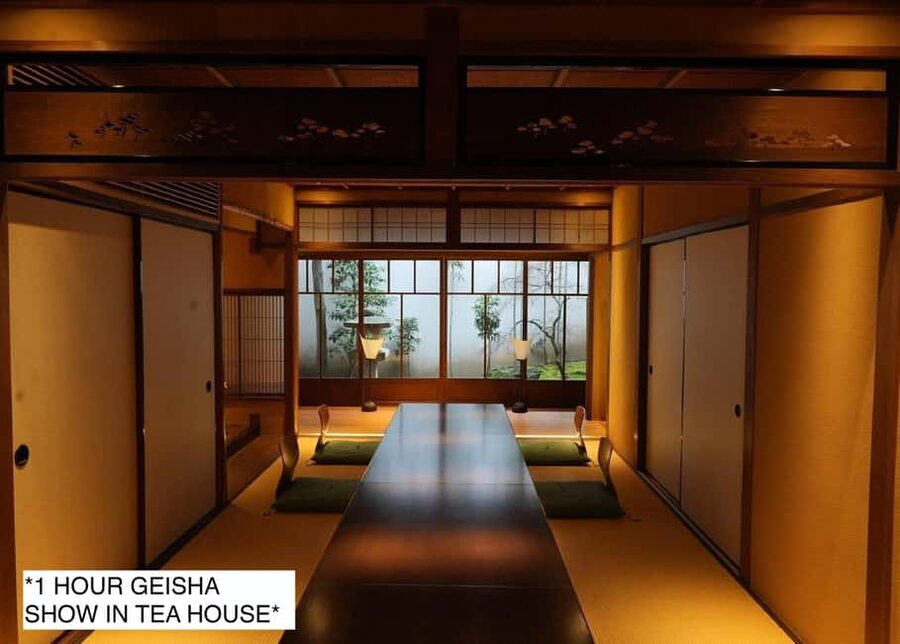
The Tea House option takes place in a traditional Kyoto-style house, a Kyo-machi-ya, and it includes a 30-minute session at Kitano Tenmangū Shrine (with the Maiko). For people who want more than a performance, this is the option that adds an extra slice of Kyoto atmosphere in a very direct way.
Another practical note from the tour rules: the Tea House option is not wheelchair accessible, while the Gion Theater option is.
Gion Theater option (showhouse focus)
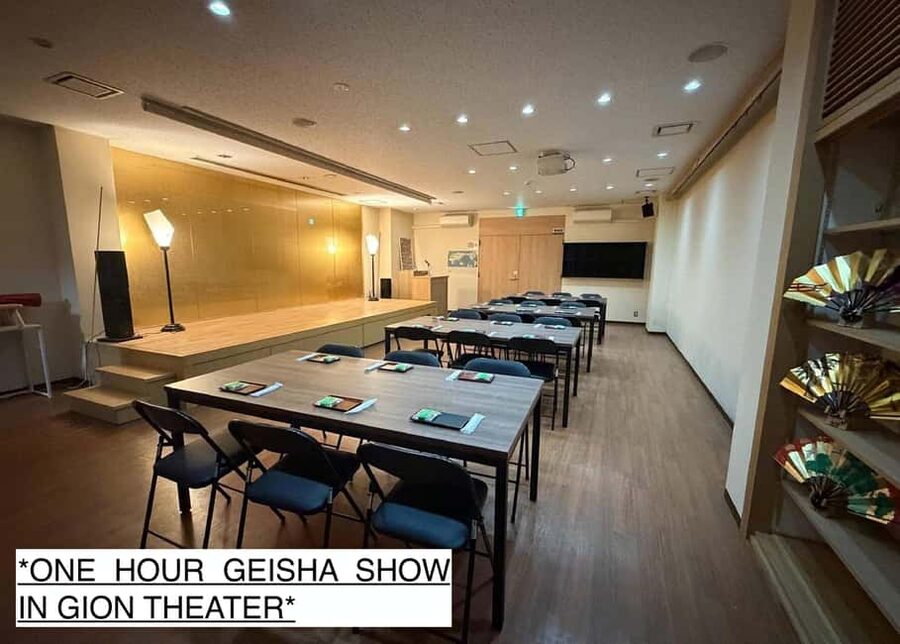
The Gion Theater option is held in a showhouse. If you want a more straightforward program with no added walking element, this can feel simpler. It also works better for wheelchair access since this option allows wheelchairs.
Either way, you still get the core experience: you meet the Maiko, watch her dance up close, and get time for questions and photos.
A change of pace from Kyoto:
- PERFECT KYOTO 1-Day Bus Tour
★ 5.0 · 13,518 reviews - Kyoto: Fushimi Inari, Kinkakuji, Bamboo Grove 1 Day Bus Tour
★ 4.8 · 4,316 reviews - Kyoto: Tea Ceremony in a Traditional Tea House in Kiyomizu
★ 4.9 · 3,519 reviews - Kyoto: Tea Ceremony Ju-An at Jotokuji Temple
★ 4.9 · 3,207 reviews
How the timing really works, and why it does not feel rushed
The event duration is listed as 1 hour to 105 minutes, and that range makes sense once you understand the structure. The schedule is not simply performance time. It is performance time plus the human parts that make it memorable: explanation, interaction, and photos.
Expect the Maiko to start with a traditional dance segment that lasts around 10 minutes, then follow with two additional brief dances (each around 5 minutes). After that, you will shift into Q&A, photo-taking, and a traditional Japanese game.
The key consideration is pacing. Since the performances are not meant to run continuously for a full hour, you should plan your expectations accordingly. If you go in expecting an hour of uninterrupted dancing, you may feel a little confused when the program transitions to questions and activities.
Meeting point, group size, and your first steps
Your meeting point may vary depending on which option you book. One listed starting location is 梅乃 UMENO (302-2 Daikokuchō, KOHYO Kamishichikenten), but the tour specifically notes that meeting and drop-off points can change based on your selected option.
Group size is also capped, and that is good news if you dislike crowded experiences:
- Tea House option: maximum 23 people
- Gion Theater option: maximum 30 people
Why I think this matters: smaller groups make the Q&A feel less like a lecture and more like a conversation. In the reviews, people repeatedly praise how guides helped with communication and ensured everyone could participate.
Also, you need to follow one simple rule from the start: wear socks. Bare feet are not allowed, and socks help everyone stay comfortable while you sit or move indoors.
The dance segments: what to watch for when it is up close
Seeing a Maiko in Kyoto is rare. The tour notes that there are only about 40 Maikos left in Kyoto, which explains why this experience feels like a limited window rather than a daily show.
When the dance begins, do not just look for movement. Look for stillness, timing, and form. Up close, you can feel how controlled the performance is. You will notice how carefully the program is paced, and how the choreography is designed for grace, not speed.
In multiple accounts, people describe the Maiko as beautiful and elegant, with a performance that feels professional and intentional. Even when the dance time is brief, the impression can be strong because you are watching it close enough to see how precise everything is.
Q&A that makes it more than a photo stop
This is one of the most praised parts of the experience. The show is built around a Q&A session, and the guiding team plays an active role in helping everything land clearly.
Guides named in the experience include Genki, Chihiro, Rin, Akari, Ai, and Taira Yoshino. Many descriptions emphasize that the guides were welcoming and informative, and that the Maiko herself was open with answers.
For you, the practical win is this: you can ask questions that help you decode what you are seeing. The tours also set you up with context before or around the dance, including explanation of what the Maiko’s dress, hair, makeup, and accessories can mean. That turns your photos from random snapshots into images you actually understand.
One caution from a real-world perspective: if your group includes people speaking multiple languages, it can sometimes be harder to follow every detail at once during the English explanation. You can reduce this by asking your own questions clearly and focusing on the main guide’s translation.
Photos, videos, and the moment afterward
You will be able to take pictures and videos during the experience, and that is explicitly part of what the tour offers. Then, after the game and Q&A, there is also time where everyone gets a chance to take a photo with the Maiko.
A small detail that shows how the experience is handled thoughtfully: one review mentions the Maiko giving a name sticker for luck after the photo moment. I cannot promise that every time, but it fits the overall tone described, warm and welcoming rather than strict and distant.
Practical tip: if you want great shots, have your phone settings ready before the dance begins. Also, keep your attention split in a smart way. Watch first for the movement, then capture the best angles when the pace gives you a clean moment.
The traditional game: interaction without pressure
After the Q&A, you get a chance to play a traditional Japanese game with the Maiko. In one account, people mention playing Konpira Fune Fune, and yes, the universal truth seems to be that most people lose.
The point is not winning. The point is participating in a cultural interaction that feels respectful and fun. If you like low-stress ways to be involved, this is the part that turns the show from a viewing experience into a memory you can replay later.
For the best time, keep your expectations simple:
- Listen when the guide explains the rules
- Follow the tempo and try
- Treat it like a shared moment, not a performance test
Tea, traditional snacks, and what you learn while you wait
This tour includes tea and traditional Japanese snacks, plus the presence of a professional tour guide. In a Tea House setting, that snack and tea moment can help you slow down. You are not rushing straight into dancing. You are settling in.
In reviews, people also mention the tea house host and additional explanation about the Maiko lifestyle. That helps you understand that this is not just about costume and dance. It is about an entire world of training, presentation, and meaning.
If you are thinking about value here, the included tea and snacks are not a throwaway bonus. They support the atmosphere. You get a short cultural “breather” that makes the show feel like it belongs in Kyoto, not just in a ticketed venue.
Kitano Tenmangū Shrine: the Tea House option adds real Kyoto atmosphere
If you choose the Tea House option, you also get a walking guided session at Kitano Tenmangū Shrine for about 30 minutes with the Maiko. This is a meaningful add-on because it connects the performance to a place, not just a room.
One review describes the flow as meeting at the starting point, going to the tea house where the Maiko was living, then enjoying the show, and finally visiting the shrine. That order matters: you carry the context from the dance and Q&A into the shrine walk, so it feels like one continuous experience.
On the other hand, if you choose the Gion Theater option, that shrine walk is not part of the program. So decide based on how much you want to do beyond watching the dances.
Price and value: is $50 worth a one-hour Maiko experience?
At $50 per person, this is not a budget activity. But the value comes from three things that are hard to replicate:
- Access to a real Maiko
The tour emphasizes how rare Maiko are in Kyoto, and that changes the economics. You are not paying for choreography alone. You are paying for a once-in-a-while cultural encounter.
- Interactive structure, not just a show
The program includes Q&A, a traditional game, and time for photos and videos. Many cultural shows are pass-fail based on the performance alone. Here, you also get conversation and participation.
- Included tea and snacks
You are not arriving hungry and leaving immediately. You get refreshments and a setting that supports the experience.
Where you might reconsider is if you want an hour of continuous performance. The Maiko performances are intentionally short. If your main goal is maximum dance time, you may prefer another type of performance or a different activity that runs longer. But if your goal is meaningful, respectful, and memorable access, this tends to hit the mark.
Photo and etiquette tips so you do not ruin the mood
This type of cultural experience has an unspoken rule: act like you are inside someone’s world, not passing through a stage show.
Here are practical things you can do:
- Wear socks as required, and avoid bare feet
- Keep your phone steady for photos, and do not block others during the dance
- Be ready for the program shift from performance to Q&A to photos
- Ask questions clearly so the guide can translate smoothly
Also, the tour notes what is not allowed: baby strollers, alcohol, and drugs. It is worth remembering because it keeps the environment calmer and more respectful.
Who this experience suits best (and who should skip it)
This is a strong match if you:
- Want an authentic Kyoto cultural encounter tied to a real Maiko
- Like interaction, not just watching
- Care about learning what the kimono, hair, and accessories can signify
- Want a guided moment that ends with photos and a clear memory
You might want to think twice if:
- You dislike structured tours and prefer unguided wandering
- You need a continuous, uninterrupted hour of performance time
- You have mobility needs that do not fit the venue option you choose
The tour also states it is not suitable for people over 95 years. If you are close to that range, double-check comfort level and transportation needs.
A quick reality check on the venue and comfort
Indoors matters here. You will be in a traditional house or a showhouse, depending on the option. The tour requires socks and prohibits bare feet, which is a small but real comfort factor. If you get cold easily, plan for cooler indoor temperatures, especially in Kyoto during shoulder seasons.
If wheelchair access is part of your planning, choose carefully: Tea House option wheelchair is not allowed, while Gion Theater option wheelchair is allowed.
Should you book this Kyoto Maiko show?
If you are trying to pick one “Kyoto cultural” experience that gives you more than a quick snapshot, I think this is a smart choice. The program combines short, high-quality dance, Q&A with a supportive guide, time to play a game, and photos and videos welcome. That blend is why people rate it so highly.
Book it if you want a rare Kyoto encounter tied to the real world of Maiko, and if you can accept that the performance is brief on purpose. Skip it if your top priority is a full hour of uninterrupted dancing, or if you cannot meet the basic requirements like wearing socks and following venue rules.
FAQ
How long does the Maiko show last?
The duration is listed as 1 hour to 105 minutes. The Maiko does not perform continuously for the full hour, since the program includes Q&A, photo-taking, and a traditional game.
What happens during the show itself?
You can expect a traditional dance segment lasting around 10 minutes, followed by two additional brief dances (each about 5 minutes). After the dances, there is time for Q&A, photos and videos, and a chance to play a traditional Japanese game.
Can I take photos and videos?
Yes. The tour explicitly welcomes pictures and videos, and you also get time for a photo with the Maiko during the experience.
What is included in the price?
The tour includes a Geisha show (1 hour), tea and traditional Japanese snacks, and a professional tour guide. A 30-minute Kitano Tenmangū Shrine session with the Maiko is included only for the Tea House option.
Are there two different show options?
Yes. The Tea House option is held in a Kyoto-style house (a Kyo-machi-ya). The Gion Theater option is in a showhouse. The shrine walking tour is only part of the Tea House option.
Do I need to wear socks?
Yes. You are required to wear socks, and bare feet are not allowed.
Is wheelchair access available?
For the Tea House option, wheelchair access is marked as not allowed. For the Gion Theater option, wheelchairs are marked as allowed.
How many people are in each group?
The maximum group size is 23 people for the Tea House option and 30 people for the Gion Theater option.
What languages are the guides?
The tour provides a live guide in English and Korean.
Latest write-ups near Kyoto
- Kyoto Private Tour Full Day with Local Guide&Nara Option(PerGroup★ 5.0 · 20 reviews
- Sacred Pathways: Discover the Philosopher’s Path of Kyoto★ 4.9 · 20 reviews
- Hammer Pattering Experience of Ring★ 5.0 · 20 reviews
- Kyoto UNESCO World Heritage Site Private Tour with a Premium Van★ 5.0 · 20 reviews
- KYOTO: Private Tea Ceremony in Hidden Townhouse (Kid-Friendly)★ 5.0 · 20 reviews
- Sushi or Traditional Japanese Cuisine in a Kyoto Home with Emika★ 5.0 · 20 reviews
- Kyoto Customized Private Tour: See Top Attractions in 1 Day★ 4.7 · 20 reviews
- The Kyoto VIP Experience!★ 5.0 · 20 reviews
Geisha & Gion Tours, compared.
Kyoto Geisha Walking Tour: Gion District & Hidden Gems
Read our review →
Gion Magical Night Walking Tour with Geisha Trivia
Read our review →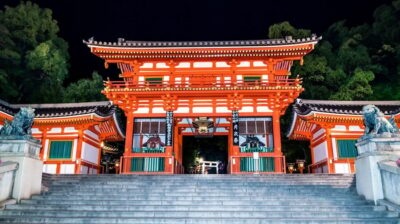
Gion Geisha District Walking Tour – Stories of Geisha
Read our review →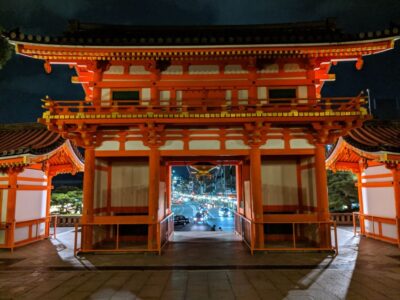
Best of Kyoto: Gion, Geisha, Pagodas & Cobblestones
Read our review →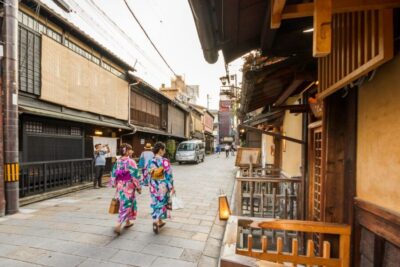

Kyoto Night Foodie Tour in Gion (9+ dishes + 6 Sake tastings)
Read our review →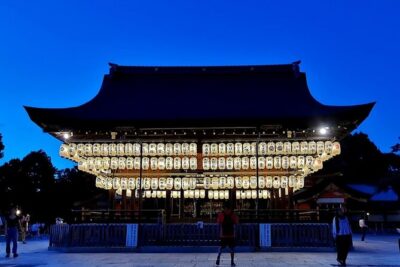
Kyoto Gion Geisha District Walking Tour – The Stories of Geisha
Read our review →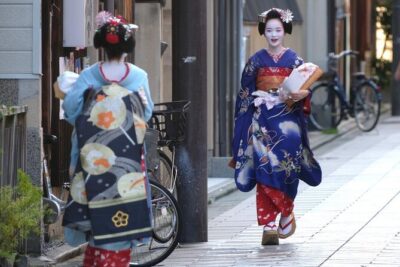
Kyoto Gion: 2-Hour Geisha Culture & History Walking Tour
Read our review →Browse the lists this tour appears in