
Reviewed · SAMURAI & NINJA EXPERIENCES
Authentic Ninja Weapon Forging Experience in Kyoto
This is interesting because you are not watching ninja stories. In Kyoto, you actually forge a handheld ninja weapon with real metalwork steps, then personalize it so you can take it home. You start in a blacksmith-style setup and work through the same stages you would expect from a crafts shop, only in a visitor-friendly format.
I especially like the hands-on shaping part, from heating and hammering to refining the edges. I also like that the session ends with kanji engraving and a dark protective finish, so your weapon feels like a genuine keepsake instead of a plain “class project.” One possible drawback: the pace is energetic and the directions can feel a little vague at times, so if you want very detailed step-by-step coaching, plan to ask questions early and often.
Key highlights I’d put on your must-do list
- You choose your weapon: shuriken in three styles, or a kunai
- No prior experience needed: you get guided coaching at each stage
- Real toolwork: hammering, refining, sharpening, and polishing with provided tools
- Customization that shows: pick a kanji character for the engraving
- A finish that looks right: blackening solution plus a final polish
A Kyoto Workshop Where You Forge a Ninja Tool, Not Just a Souvenir
Kyoto has a lot of cultural experiences. This one is different because the end product is physical and very specific: a ninja weapon you shape yourself. The activity runs about 2 hours 30 minutes, and it keeps you busy the whole time, from suiting up to finishing work on your metal.
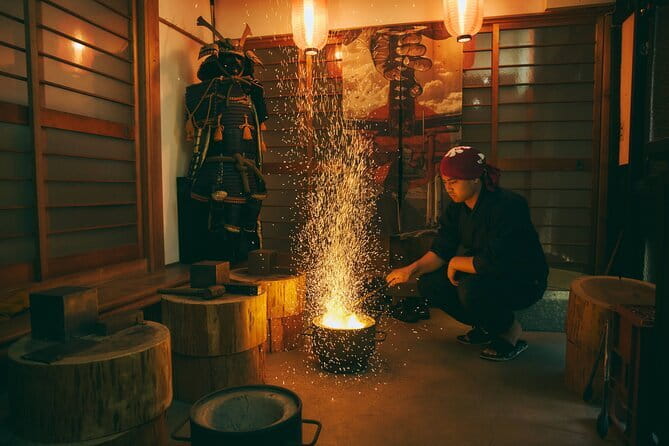
You begin by stepping into a craftsman atmosphere. You do not just put on a costume for photos. You change into samue, the traditional blacksmith uniform, and wrap a tenugui around your head. That small ritual matters because it helps you mentally shift into maker mode. Even if you’re not a “craft person,” you’ll find it easier to focus once everyone around you is working the same way.
The studio is small, with a maximum of 25 people, so you are not stuck in a huge, impersonal crowd. That matters for safety when you’re near hot metal and power tools, and it also helps staff get you back on track if your technique slips.
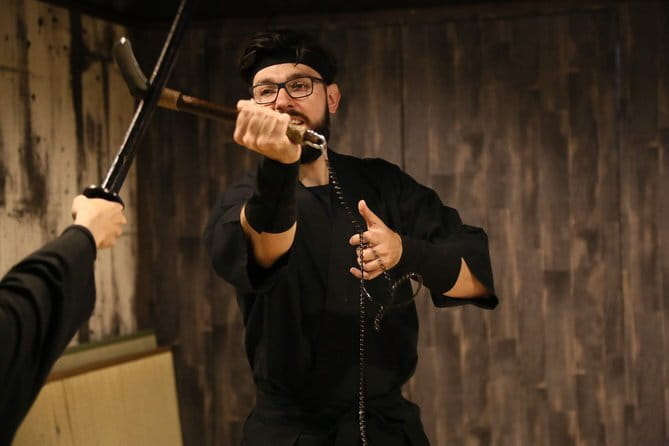
The overall tone is high-energy and fun. Staff members are described as friendly, patient, and enthusiastic, including someone named Taka who gets called out for helping people make their kunai more symmetrical. In practice, that means you should expect clear encouragement and active coaching, not “watch and hope” teaching.
More Samurai & Ninja Experiences in Kyoto
- Kyoto Samurai Experience
★ 5.0 · 1,294 reviews - Kyoto: Kendo and Samurai Experience with Uniform and Gear
★ 4.9 · 815 reviews - Kyoto: Samurai Sword Class by Experts in Traditional Arts
★ 4.9 · 657 reviews
What You Make: Shuriken Styles and a Kunai You Can Personalize
Before the forging starts, you pick your weapon. You can choose from three shuriken styles or one kunai. The difference is not just cosmetic. Even in short workshops, different shapes tend to demand different hand positioning, especially during the refining and polishing steps.
If you’re deciding between shuriken and kunai, think about what you want to display or carry home. Shuriken designs can feel more “traditional ninja tool” and sculptural in a display box. A kunai usually reads as more of an all-purpose tool, and many people seem excited about shaping it carefully and engraving it.
Your personalization comes right after shaping. You choose a kanji character, and the staff engraves it with precision. This part is a big value-add. A lot of souvenirs are generic. Here, your choice of kanji makes the object feel like yours, even if your first attempt at perfect symmetry is not instantly perfect. Staff support helps, and you can leave with something you feel proud to show.
The 2.5-Hour Flow, From Ninja Suiting Up to Final Polish
This experience is structured like a real production path, just compressed into a visitor workshop. Here’s what your time blocks look like, and what each one really means for you.
1) Suit up like a ninja craftsman
You change into samue and wrap the tenugui. It’s included, and so are the tools and setup needed for the metalwork. Expect a quick orientation and then you get pulled into the making process.
Why this is valuable: it sets expectations. You are treated like a maker, not a tourist.
A change of pace from Kyoto:
- PERFECT KYOTO 1-Day Bus Tour
★ 5.0 · 13,518 reviews - Kyoto: Fushimi Inari, Kinkakuji, Bamboo Grove 1 Day Bus Tour
★ 4.8 · 4,316 reviews - Kyoto: Tea Ceremony in a Traditional Tea House in Kiyomizu
★ 4.9 · 3,519 reviews - Kyoto Geisha Walking Tour: Gion District & Hidden Gems
★ 4.7 · 3,273 reviews
2) Choose your ninja weapon style
You select one of the three shuriken styles or a kunai. You’re not asked to sketch designs or invent anything. This is about shaping a defined form, with you doing the hands-on work.
What to watch for: once you pick, commit mentally. The rest of the session flows around that shape.
3) Forge the steel in an 800°C furnace
The core moment is the forging step. You heat your metal in an about 800°C furnace, then hammer it while it’s hot. The workshop includes specialized equipment for the process, and you’re guided through safe handling.
Even if you don’t know how to hold a hammer properly, the staff coaching is the point. The feedback from people who loved this experience is consistent: they felt they could actually do the techniques, not just pose for action shots.
Practical consideration: this step is physically active. Your “moderate physical fitness level” matters here, especially if you tire easily with hammering or sustained standing.
4) Shape the blade with a belt sander
After forging, you refine the metal. The workshop uses a professional belt sander to help refine and sharpen the weapon shape.
This is where the experience balances authenticity with accessibility. Real metalwork can take ages by hand. In a 2.5-hour class, tools like a belt sander let you actually finish a polished, presentable item without turning the session into a marathon.
If you’re worried about manual stamina: some people note that there are options for sharpening that require less manual work. That’s a good sign that the workshop is designed to include kids and adults.
5) Kanji engraving, your choice made real
Next comes the engraving. You pick a kanji character, and staff engrave it precisely.
Why I like this part: it’s the moment where the workshop shifts from generic craft to personal artifact. The object stops being a “thing you made” and becomes “the weapon with my character on it.”
6) Ninja knowledge session
Then you get a knowledge session about ninja history, weapons, and secret techniques. It ties back to what you made, so the talk does not feel disconnected.
What to expect: it’s educational, but it’s also meant to add meaning while you’re finishing. If you enjoy context, this is the part that turns the forge into a story you can remember.
7) Blacken the steel for that authentic dark finish
You apply a special solution to protect the metal and create a dark finish similar to the look of an authentic tool.
This step matters because the final color is part of the “ninja vibe.” Without it, the weapon can feel unfinished, like raw metal. With it, it looks like a tool you could imagine using, at least in the cinematic sense.
8) Final polish, then you’re done
You polish your weapon to bring out shine.
Polishing is one of those steps that feels oddly satisfying. You see the shape turn from “worked metal” into something clean and display-ready. People also mention leaving with a well-made keepsake, and the inclusion of storage supports that feeling.
Safety, Pacing, and the One Thing You Should Be Ready For

This workshop is structured for action, not slow artistry. That is a good thing for most people. It’s also the reason one possible drawback comes up in feedback: sometimes directions can feel vague.
Here’s how I’d handle that if you’re aiming for maximum value:
- Ask one clear question early if you don’t understand the next step.
- Pay attention during the first time you’re shown how to refine or handle tools.
- If your group is moving fast, you still control your pace by asking what to do next.
The positive side of the pacing is that many people say time flew and the process was organized. The staff come off as friendly and high-energy, so you are likely to feel guided and supported even when the instructions are not super detailed.
Also, because there is metal heating, hammering, sanding, and chemical blackening involved, moderate physical fitness is wise. If you have mobility issues, you might want to consider whether standing and working at a bench for a couple of hours is comfortable for you.
Your Take-Home Ninja Weapon: Box, Finish, and Travel Reality
You finish with a weapon you can store and transport. The experience includes a clean box and bag to take home, which is not just a nice extra. It directly affects whether you can bring your souvenir back without turning it into a scraped, damaged mess.
People also report putting the weapon in checked luggage. That’s a good sign that the item can handle normal travel when stored in the provided case setup.
What you should do at home is simple: keep it in the bag or box. Don’t treat it like a toy. The blackened finish and the protective solution are part of the final result, and you want to preserve that look.
Also, consider the weight and sharpness if you’re packing it in a backpack. You’re taking home a real metal object, even if it is meant as a souvenir. Plan to pack it so it can’t poke through or scuff other items.
Price and Value: Why This Costs What It Costs
The price is $151.92 per person, and the booking page shows it’s selling. At this cost, you’re not paying for a museum ticket or a guided walk. You’re paying for:
- a guided metal shaping process,
- use of specialized tools (including files, hammers, and the equipment used for refining),
- the uniform rental,
- staff time for safety and coaching,
- and the included take-home box and bag.
That’s the key value point. Many craft activities charge for a “participation experience,” where you do one small action and mostly watch. This one is built around you actively doing multiple steps, including forging and refining. Even the most cautious beginner can usually keep up because staff coach you through each stage.
Still, I’ll be honest. One piece of feedback calls the pricing high and suggests the experience felt like a conveyor belt with limited weapon-making. That’s a minority view, but it’s enough to matter. My advice is to show up engaged and ask to do the tasks yourself, especially during forging and refining. The workshop is designed for hands-on participation, but your payoff improves if you treat it like you’re there to work.
If you want a memorable Kyoto activity that produces a personalized object, the price can feel justified. If you only want a light, low-effort photo stop, you might feel it’s too much compared with other options.
Where It Runs, and Why the Location Matters
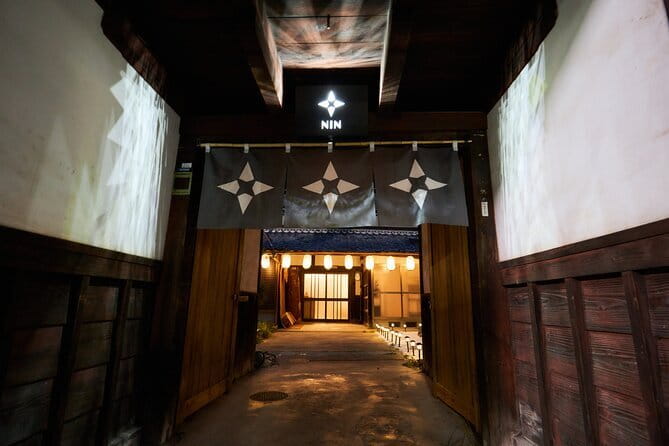
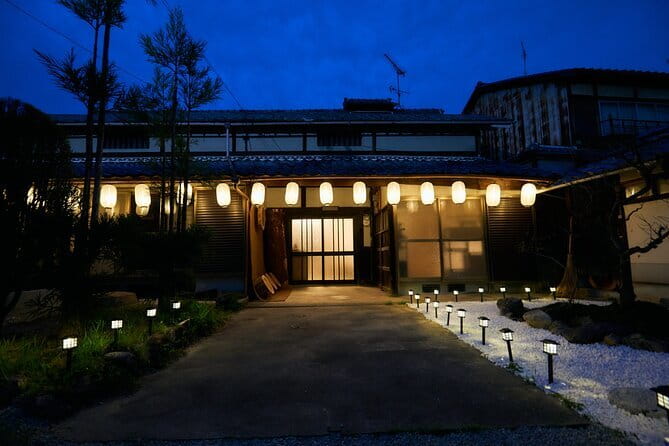
The meeting point is studio NIN, Yasenosechō, Sakyo Ward, Kyoto (address: 八瀬168-1 Yasenosechō, Sakyo Ward, Kyoto, 601-1254, Japan). The activity ends back at the meeting point.
It can be off the beaten path. That’s not automatically a dealbreaker, but it does mean you should plan your ride. If you rely on taxis, have a taxi app ready. People recommend that for getting there smoothly.
The good part: you’re near public transportation. So if you’re comfortable using buses or trains and then walking a bit, you can make it work without too much hassle.
Who This Is For (and Who Might Skip It)
This is a great fit if:
- you want a hands-on Kyoto experience with a real outcome,
- you like weapon lore and want a practical reason behind it,
- you enjoy customizing items with a kanji character,
- and you like learning by doing, not just watching.
It’s also a strong choice for mixed groups. People mention it working well for families with teens and even kids, as long as everyone can handle the basic physical effort.
You might want to skip or choose a different activity if:
- you dislike physically active tasks, especially hammering or standing for long stretches,
- you need extremely detailed, instructor-by-instructor directions with no ambiguity,
- or you want a softer, more relaxed cultural stop.
Should You Book Atelier NIN for Ninja Weapon Forging in Kyoto?
If you want a Kyoto souvenir with real craft behind it, I think you should book. This is one of those rare classes where you do the key steps that make the object, not just the final decoration. The high satisfaction is easy to understand: people love leaving with a personalized kanji engraving, a dark authentic finish, and a weapon they shaped themselves, helped along by staff who are friendly and high-energy.
Just go in with the right mindset. You will be doing metalwork. Wear your patience, ask questions if anything is unclear, and treat it like a workshop rather than a quick photo stop. If you do that, the $151.92 price usually feels like a fair trade for a genuinely memorable, take-home result.
FAQ
How long is the ninja weapon forging experience?
It runs about 2 hours 30 minutes.
What weapons can I make in this class?
You can choose from three shuriken styles or make one kunai.
Do I need any prior experience with metalwork?
No experience is required. Skilled craftsmen teach you step by step.
Is transportation included in the price?
No. Private transportation is not included.
Where is the meeting point?
The meeting point is studio NIN at 八瀬168-1 Yasenosechō, Sakyo Ward, Kyoto, 601-1254, Japan.
What should I know about physical effort?
The experience calls for a moderate physical fitness level.
What is the cancellation window?
Free cancellation is available up to 24 hours in advance for a full refund. If you cancel less than 24 hours before the start time, the amount paid is not refunded.
Latest write-ups near Kyoto
- Kyoto Private Tour Full Day with Local Guide&Nara Option(PerGroup★ 5.0 · 20 reviews
- Sacred Pathways: Discover the Philosopher’s Path of Kyoto★ 4.9 · 20 reviews
- Hammer Pattering Experience of Ring★ 5.0 · 20 reviews
- Kyoto UNESCO World Heritage Site Private Tour with a Premium Van★ 5.0 · 20 reviews
- KYOTO: Private Tea Ceremony in Hidden Townhouse (Kid-Friendly)★ 5.0 · 20 reviews
- Sushi or Traditional Japanese Cuisine in a Kyoto Home with Emika★ 5.0 · 20 reviews
- The Kyoto VIP Experience!★ 5.0 · 20 reviews
- Kyoto Customized Private Tour: See Top Attractions in 1 Day★ 4.7 · 20 reviews
Samurai & Ninja Experiences, compared.

Samurai Ninja Museum Guided tour and Experience
Read our review →
Kendo and Samurai Experience with Uniform and Gear
Read our review →
Samurai Sword Class by Experts in Traditional Arts
Read our review →
Skip the lines Basic Ticket at SAMURAI NINJA MUSEUM KYOTO
Read our review →
Samurai Sword & Archery Class from Samurai Descendant
Read our review →
Browse the lists this tour appears in