Reviewed · GUIDED
Kyoto 8hr Private Tour with Government-Licensed Guide
Kyoto can feel like one long blur of torii gates, temple roofs, and camera shots. What makes this tour different is that you get a government-licensed English guide who helps you choose a tailored route and gives you the why behind what you see, not just the where. I like that you can steer the day toward temples, neighborhoods, or food streets, and still keep a sensible walking flow.
I also like the way the tour handles Kyoto’s crowd pressure. You’ll hit major sights like Fushimi Inari-taisha and Kiyomizu-dera with guidance, then shift into areas such as Gion, Nishiki Market, and Pontocho so your day feels both iconic and practical. One possible drawback: this is a walking tour, with pickup and drop-off on foot, so you should be ready for a solid day of moving around.
Key things that make this Kyoto private tour work
- Government-licensed English guide who plans around your interests after you book
- Private format with only your group, plus meet-up on foot within the designated area
- Flexible stop selection from a large list of temples, markets, and historic districts
- Smart mix of famous and quieter spots, from Gion lanes to Zen gardens
- Mobile ticket included, with free cancellation up to 24 hours before start
Private, licensed guide and on-foot pickup that saves your brain
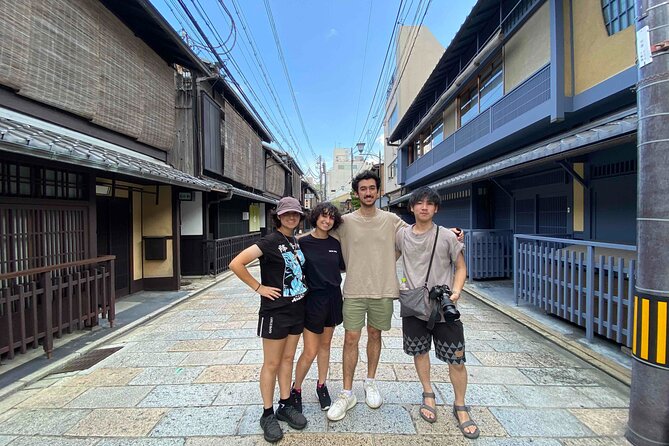
This is a private tour, so you are not sharing your day with strangers. The guide meets you on foot inside a designated Kyoto area, and pickup and drop-off are handled on foot too. Translation: you still do walking, but you avoid the stress of figuring out the “where do we meet” part.
The big value is the guide being government-licensed. That usually means smoother coordination, clearer explanations, and better instincts for what to prioritize. And it shows in how guides handle different group needs. For example, Karkoo Tanigawa is specifically mentioned as helpful and accommodating for a party of six, which is exactly the kind of small-group attention you want on a long day.
If you dislike uncertainty, this setup helps. You pick your target stops, or you ask for a recommended itinerary based on your interests, then you follow the plan your guide builds.
Also on the shortlist for Kyoto:
- PERFECT KYOTO 1-Day Bus Tour
★ 5.0 · 13,518 reviews - Kyoto: Fushimi Inari, Kinkakuji, Bamboo Grove 1 Day Bus Tour
★ 4.8 · 4,316 reviews - Kyoto: Tea Ceremony in a Traditional Tea House in Kiyomizu
★ 4.9 · 3,519 reviews
How the 8-hour day is built, and what you should decide upfront
The tour is about 8 hours. In the planning stage, you can choose around 3 to 4 spots you want to see, and the overall framework is designed around selecting 4 to 6 sites from the options. Either way, the goal is quality over racing from one landmark to the next.
Before you confirm, think about how you want your Kyoto to feel:
- Do you want “greatest hits” like Fushimi Inari, Kiyomizu-dera, and Gion?
- Or do you want more temples, gardens, and calm walking lanes in places like Higashiyama and Arashiyama?
- Are you more into architecture and layout, or into rituals like visiting temple grounds and exploring historic streets?
When you don’t know where to start, the guide can send a recommended itinerary based on what you tell them. That’s a smart option if this is your first Kyoto visit and you’d rather not spend your trip doing homework.
One more practical thing: the stop times in the tour plan are short blocks. Many stops are around 10 to 15 minutes. A couple are longer, like 30 minutes for Sanjusangendo and Eikando. So expect photo time, viewpoint time, and guided context, not slow, all-day wandering at every single stop.
Fushimi Inari-taisha and Kiyomizu-dera: two Kyoto icons, made easier
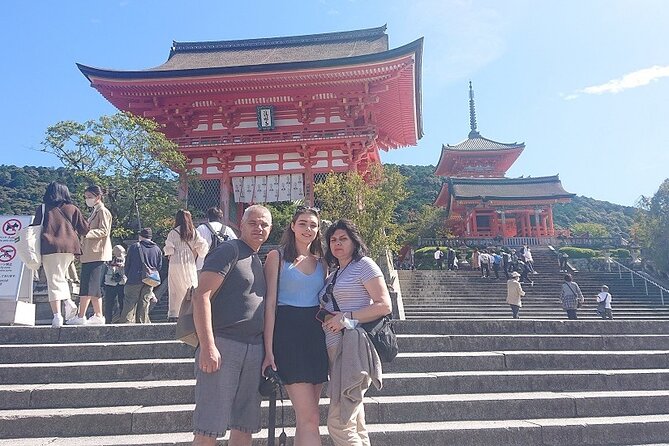
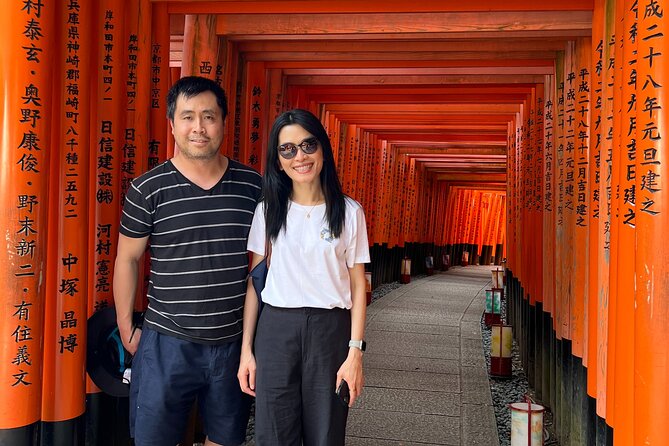
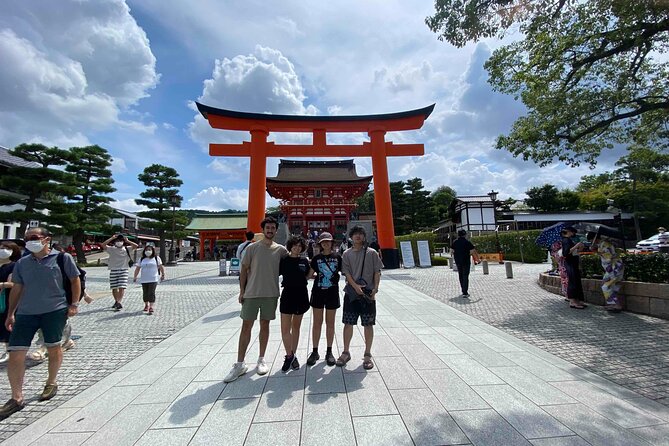
Fushimi Inari-taisha Shrine is often where first-time Kyoto trips start, and it’s easy to see why. With guidance, you get the main flow without getting stuck in wrong turns. The tour lists this as a short stop, about 15 minutes, and admission is free for the shrine area listed here. You’ll likely focus on the classic torii sequence and immediate viewpoints rather than trying to do the entire mountain route.
Kiyomizu-dera is the other “must” on many lists. The tour frames it as a guided stop (about 15 minutes in the schedule), and admission is not included for this stop. Kiyomizu-dera gets crowded, so the best benefit of a guide is not just the facts. It’s the pacing and the sense of what to look for while you’re there.
If you’re choosing only a few top sights, these two are strong picks. They also work well as anchors. After them, your guide can shift you into nearby neighborhoods and streets where the day feels less like a checklist.
Gion, Nishiki Market, and Pontocho: history with a food-street brain
Gion is famous, but it can be confusing on your first pass, especially if you’re trying to find the right lanes and viewpoints. A guided visit makes the difference between wandering and actually seeing the character of the district. The plan lists it as a short, about 15-minute stop, with admission free.
Next up, Nishiki Market is a great change of pace. The tour describes it as Kyoto’s Kitchen, a narrow, five-block shopping street lined with many shops and places to snack. This stop is also about 15 minutes, and admission is free. Even if you do not buy anything, you learn how locals think about daily food and seasonal tastes.
Then consider Pontocho, the atmospheric dining alley one block west of the Kamogawa River. It’s included as a free stop, about 15 minutes. Pontocho is the kind of place where a little timing and orientation matters. A guide can point out what to look for without you needing to guess your way through.
If your Kyoto dream includes lanes, scents, and quick bites, these three stops are a solid combination for an 8-hour walk.
A change of pace from Kyoto:
- Kyoto Geisha Walking Tour: Gion District & Hidden Gems
★ 4.7 · 3,273 reviews - Kyoto: Tea Ceremony Ju-An at Jotokuji Temple
★ 4.9 · 3,207 reviews - Kyoto: Gion Magical Night Walking Tour with Geisha Trivia
★ 4.9 · 2,393 reviews - Kyoto: 45-Minute Tea Ceremony Lesson Experience
★ 4.3 · 2,378 reviews
Higashiyama Ward: when the streets do the storytelling
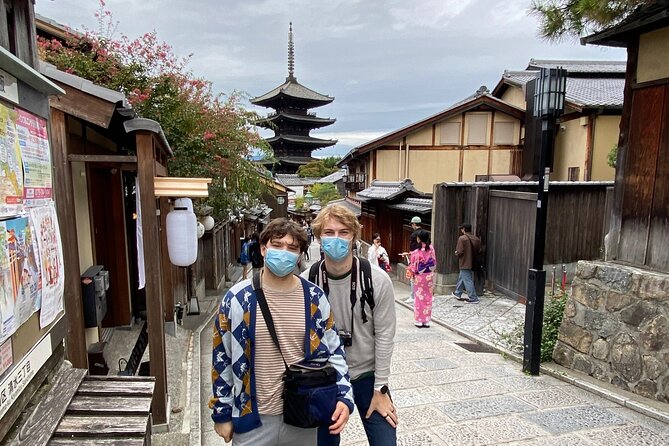
Higashiyama Ward is listed as a free stop and a way to experience well-preserved old Kyoto, especially along the lower slopes of the eastern mountains. The schedule lists this as a short visit (about 15 minutes). In practice, this is where your guide helps you connect dots. You start to see how neighborhoods, temple approaches, and hillside layouts shape the feel of Kyoto.
This is also a good area to manage expectations. Higashiyama attracts a lot of foot traffic. A guide helps you pick the most photogenic angles and the best quick routes so you keep moving and do not get stuck in slow crowds for long stretches.
Castles and imperial power: Nijo Castle and Kyoto Imperial Palace
If you want Kyoto beyond temples, these two stops help balance the day.
Nijo Castle is listed as a UNESCO World Heritage site, built in 1603 as the Kyoto residence of Tokugawa Ieyasu. The schedule lists it as about 15 minutes, and admission is not included. The main drawback of short castle visits is that it’s easy to miss what makes the place special if you treat it like a photo stop. A guide changes that by pointing out the key parts to notice within a quick timeframe.
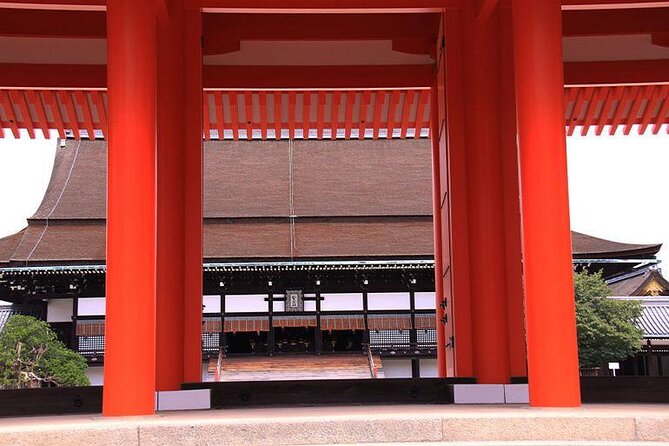
Kyoto Imperial Palace is another “big name” site. The tour describes it as the former residence of Japan’s Imperial Family until 1868, when the emperor and capital moved to Tokyo. It’s listed as a free stop in this plan context, and admission is not included here. Also plan for a similar issue to Nijo: if you only glance, it can feel like a lot of grounds. Guided context helps you understand what you’re looking at, fast.
Zen temples, gardens, and the best way to pick your favorites
Kyoto’s Zen temples can become a blur if you try to see too many. The tour helps because you choose your stops, and each one gives a different flavor. Here are some of the temple options in the tour list, plus what they’re good for.
Ginkakuji, Nanzenji, Toji, and Tofuku-ji
Ginkakuji (Silver Pavilion) is listed as about 15 minutes, with admission not included. Even if you know it only by name, this stop is often chosen for its garden and calm approach. If you like quiet architecture and the idea of “less, but careful,” it fits.
Nanzenji Suirokaku is a Zen temple stop listed at about 15 minutes, with admission not included. Nanzenji is known for spacious grounds, and that scale can feel different from smaller temple courtyards.
Toji is included as about 15 minutes and noted as a free admission free stop in the plan. It’s a huge site, tied to the Heian period and the early Kyoto capital. If you want one temple stop that feels more “worldly” in scale, Toji can be a good anchor.
Tofuku-ji is listed as a large Zen temple and famous for autumn colors, about 15 minutes, with admission not included. Even outside peak season, your guide can help you see what makes the place special when the light hits the grounds.
Kinkakuji and Ninna-ji: gold, ceremony, and strong identity
Kinkakuji (Golden Pavilion) is one of Kyoto’s signature sights. The plan lists it at about 10 minutes with admission not included. The temptation here is to see only the postcard image. With guidance, you tend to notice the setting and how the gold-leaf look changes depending on where you stand.
Ninna-ji is another World Heritage listed temple option. It’s about 10 minutes, with admission not included. It’s a good selection if you want a more varied temple complex experience, and you’re okay with quicker, guided highlights rather than slow exploration.
Eikando and Sanjusangendo: longer stops that break up the day
Two entries are longer in the plan and can be great choices if you want less rushing.
Eikando Zenrinji is listed for about 30 minutes. Admission is not included. It’s especially known for autumn colors and also for evening illumination. Even if you’re not visiting in autumn, your guide can help you appreciate why it’s such a popular seasonal pick.
Sanjusangendo (Rengeo-in) is listed for about 30 minutes as well, with admission not included. It’s famous for 1001 statues of Kannon. The drawback here is that the sheer scale can feel overwhelming. A guide’s narration helps you see the pattern without losing your focus.
Kennin-ji and the quick hit strategy
Kennin-ji is listed as close to Hanamikoji and Shijo streets. In the schedule it’s a very short stop, about 1 minute, with admission not included. When a temple gets that little time, it works best as a “pause and orient” moment. A guide can still add value by explaining what to notice in a tiny window.
Arashiyama and beyond: bamboo, bridges, and calm contrast
Arashiyama is a great place to balance your day. It’s still touristy, but it offers a different feel than central Kyoto streets.
Arashiyama itself is included as a district choice, about 10 minutes, with admission not included. The plan also highlights the Togetsukyo Bridge, the “Moon Crossing Bridge.” The bridge is the iconic landmark. The plan gives a Heian period origin and notes a reconstruction in the 1930s. This stop does not list admission, and in practice it’s mainly a scenic walk-and-look moment.
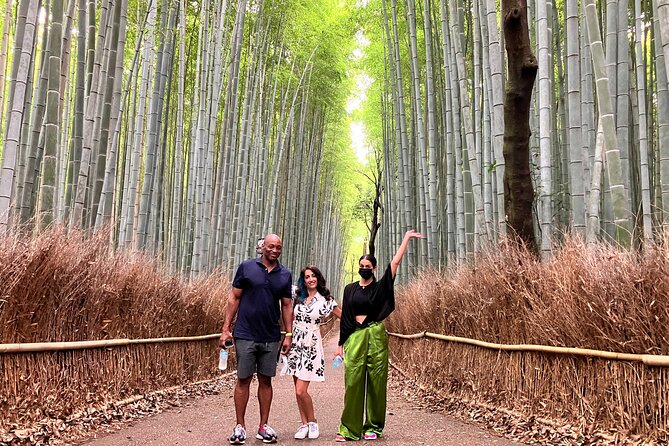
Then comes the bamboo groves, described as a walk-through area. Again, this is more about the experience of walking the paths and watching bamboo sway than about paying for an attraction. It’s perfect for a short breather between bigger temple stops.
If your itinerary includes more structured temple options in the area:
- Tenryu-ji is listed as a key Arashiyama Zen temple, about 10 minutes, with admission not included.
- Daikaku-ji is about 10 minutes, with admission not included, described as a calm Sagano district temple tied to Emperor Saga.
- Okochi Sanso Garden is about 10 minutes, with admission not included, located behind Arashiyama bamboo. It’s the former villa of actor Okochi Denjiro, and it’s a great choice if you want garden-focused Kyoto rather than temple-focused Kyoto.
- Katsura Imperial Villa is about 10 minutes, with admission not included, and it’s known for architecture and garden design tied to the 17th century.
Ryoan-ji and the rock garden reality check
Ryoan-ji is included as the site of Japan’s most famous rock garden, listed at about 10 minutes, with admission not included. The drawback is that the rock garden can look simple if you visit with no context. With guidance, you can understand how to look without chasing every tourist angle.
Smaller hillside temples around Arashiyama
The tour list includes several hillside temple options that tend to feel quieter than the big names:
- Jojakkoji, Nisonin, Gio-ji (each about 10 minutes, all with admission not included)
- Adashino Nenbutsu-ji and Otagi Nenbutsu-ji (each about 10 minutes, with admission not included)
These are great for a Kyoto day that wants texture, moss, stone, and small gates, not just signature buildings.
If you like understated atmosphere and photos that look “less crowded,” these are the picks to ask your guide about.
Northern Kyoto stops: Kibune and Kurama for a slower-feeling day
If your guide is building in a northern direction, you might include:
- Kibune River, about 10 minutes, listed as free
- Kurama-dera, about 10 minutes, with admission not included
These northern mountain-adjacent stops can shift your day away from dense city lanes. The plan describes Kibune as a small town in a forested valley that developed around Kifune Shrine, and it mentions legend about a goddess traveling by boat. Kurama is described as rural, less than an hour from the city center, and known for Kurama-dera and a hot spring (the plan calls it one of the most easily accessible).
The practical takeaway: these stops can be a reset button. If you’re tired of crowds, a northern approach often gives your legs and mind a break.
Price and value: what you’re really paying for at $201.46 per person
At $201.46 per person, you’re buying a government-licensed English guide for an 8-hour private walking day plus a mobile ticket and a customizable route. That can be good value in Kyoto because you are not just paying for entry to sights. You are paying for time saved, better sequencing, and clearer explanations at places that can otherwise feel overwhelming.
Here’s what’s not included, and it matters for budgeting:
- transportation fees
- entrance fees
- lunch
- other personal expenses
- private vehicle
Also, guide entry fees are only covered for sights listed under the tour’s “What to expect” set. So you should still plan to pay some admission depending on which stops you choose, especially for the temples marked as admission not included.
If you’re traveling as a group, the tour mentions group discounts, which can make the per-person price feel more comfortable. If you’re traveling solo or as a couple, it’s still often worth it if you want fewer mistakes and fewer logistics problems in one day.
Tips so your feet and photos both survive this 8-hour Kyoto walk
This is a walking tour with meet-up and movement on foot. That means footwear matters. Choose shoes that handle uneven pavement and temple steps, and keep water and snacks in mind since lunch is not included.
Because your stop times can be short, go in with a target list. If you’re picking between a big-name temple and a smaller hillside option, ask your guide what each one will feel like in real time. You can also ask your guide to balance your day across areas, for example starting with a shrine, then moving into Higashiyama, then shifting to Arashiyama.
Finally, lean on your guide for pacing. The best guides do not just “show you the place.” They manage your attention span, crowd flow, and timing.
Should you book this Kyoto private tour?
Book it if you want a structured Kyoto day without the planning stress. It’s especially a good fit for first-timers who want a mix of highlights like Fushimi Inari-taisha, Kiyomizu-dera, Gion, and Nishiki Market, plus enough temple and garden time to feel like you actually learned something about Kyoto.
Skip it or reconsider if you want minimal walking, or you already know Kyoto well enough to build a route faster on your own. Because this plan is built around walking and short guided stops, it rewards people who like a guided rhythm.
If you do book, pick your must-sees early, then let the licensed guide tighten the route. That’s where the day feels worth it.
FAQ
How long is the Kyoto private tour?
The tour is approximately 8 hours.
Is this tour private?
Yes. It’s a private tour, and only your group will participate.
Do I need to pay for entrance fees?
Entrance fees are not included. The tour notes that guide entry fees are covered only for sights listed under what to expect.
Is pickup offered?
Pickup and drop-off are on foot, with you meeting the guide within a designated area of Kyoto.
How many places can we visit?
The tour is customizable. You choose 3 to 4 spots you want to visit, and the customizable tour is described as selecting 4 to 6 sites from the what-to-expect list.
What is included in the price?
Included features are a licensed local English-speaking guide, a customizable tour of your chosen sites, and a mobile ticket.
Can I cancel for a full refund?
Yes. Free cancellation is available, and you can cancel up to 24 hours in advance for a full refund.
Latest write-ups near Kyoto
- Kyoto Private Tour Full Day with Local Guide&Nara Option(PerGroup★ 5.0 · 20 reviews
- Sacred Pathways: Discover the Philosopher’s Path of Kyoto★ 4.9 · 20 reviews
- Kyoto UNESCO World Heritage Site Private Tour with a Premium Van★ 5.0 · 20 reviews
- Hammer Pattering Experience of Ring★ 5.0 · 20 reviews
- KYOTO: Private Tea Ceremony in Hidden Townhouse (Kid-Friendly)★ 5.0 · 20 reviews
- Sushi or Traditional Japanese Cuisine in a Kyoto Home with Emika★ 5.0 · 20 reviews
- The Kyoto VIP Experience!★ 5.0 · 20 reviews
- Kyoto Customized Private Tour: See Top Attractions in 1 Day★ 4.7 · 20 reviews
Guided, compared.
Tokyo 6hr Private Tour with Government-Licensed Guide
Read our review →
Shinjuku Local Bar and Izakaya Guided Walking Tour
Read our review →
Private City Highlights Tour with Local Guide
Read our review →
Kyoto Early Morning Tour with English-Speaking Guide
Read our review →
Tokyo 4hr Private Tour with Government-Licensed Guide
Read our review →
Kyoto 6hr Private Tour with Government-Licensed Guide
Read our review →