
Reviewed · GEISHA & GION TOURS
Kyoto: Tea Ceremony with Maiko Premium
Kyoto tea culture is usually something you watch from the edge. This experience is interesting because you get a real maiko in front of you, learning the basics of matcha while you’re sitting close enough to feel the calm and focus.
I love the Q&A moment where you can ask about training and daily life in plain, direct terms. I also love the photo time right beside her, plus little ceremonial extras like a lucky charm.
One consideration: the setup is not a classic private tatami tea house. The program happens in a building with tables and stairs, and the photo background can be busy if you are unlucky with angles.
Key highlights to plan for
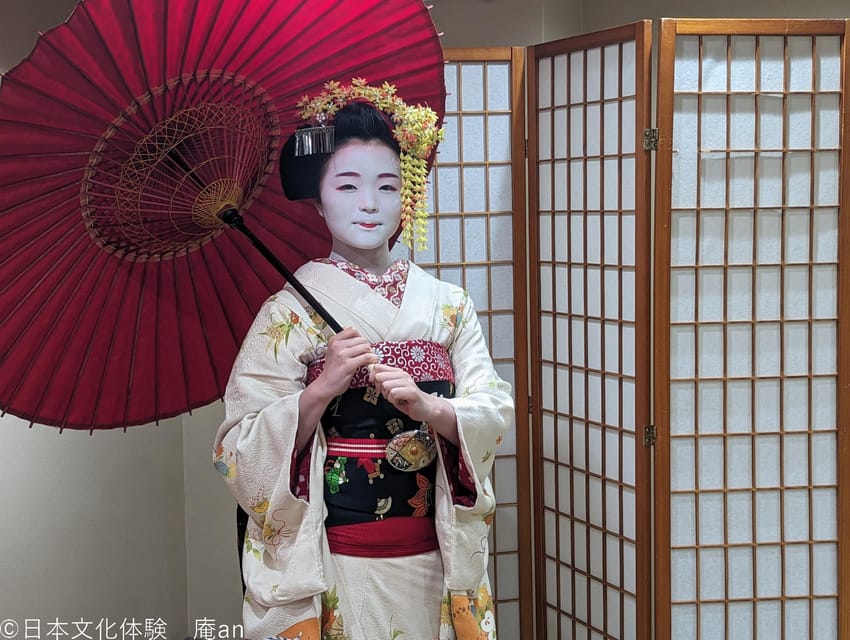
- Maiko, with a possible Geiko swap: Depending on the situation, you might be introduced to a Geiko instead of a maiko.
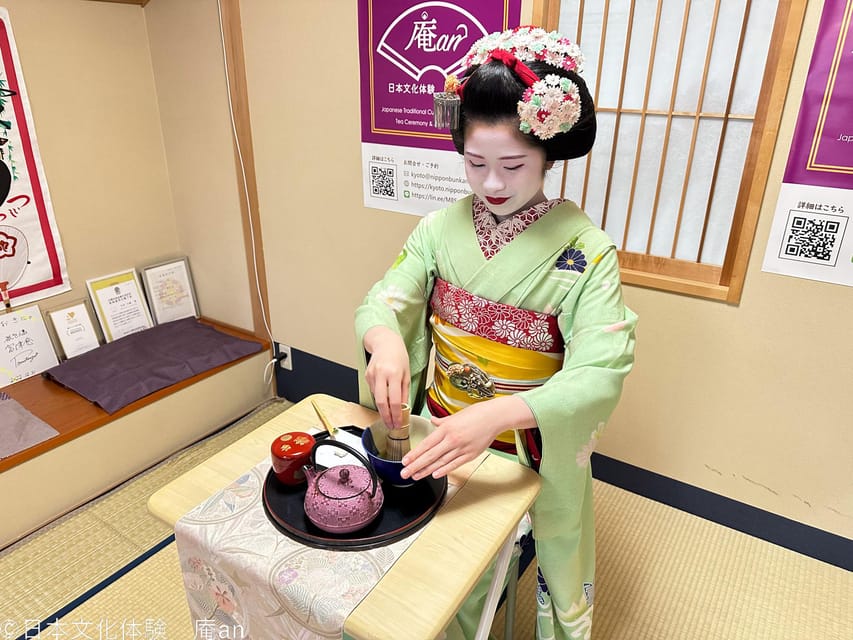
- Matcha you actually make: You learn, then you make your own tea with guidance.
- Two sweets are part of the flow: You get two dried-type Japanese sweets alongside the matcha moment.
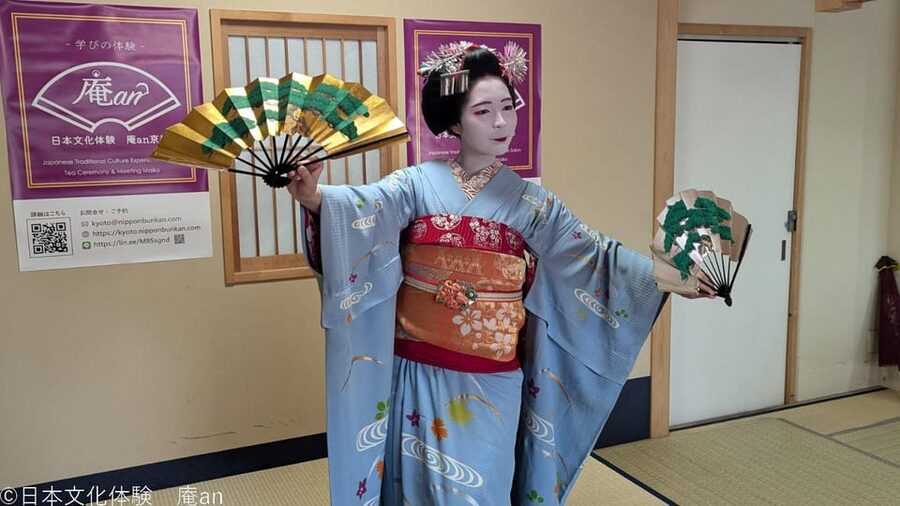
- Dances plus a playful game: You watch two traditional dances, then you may even join a simple interactive game.
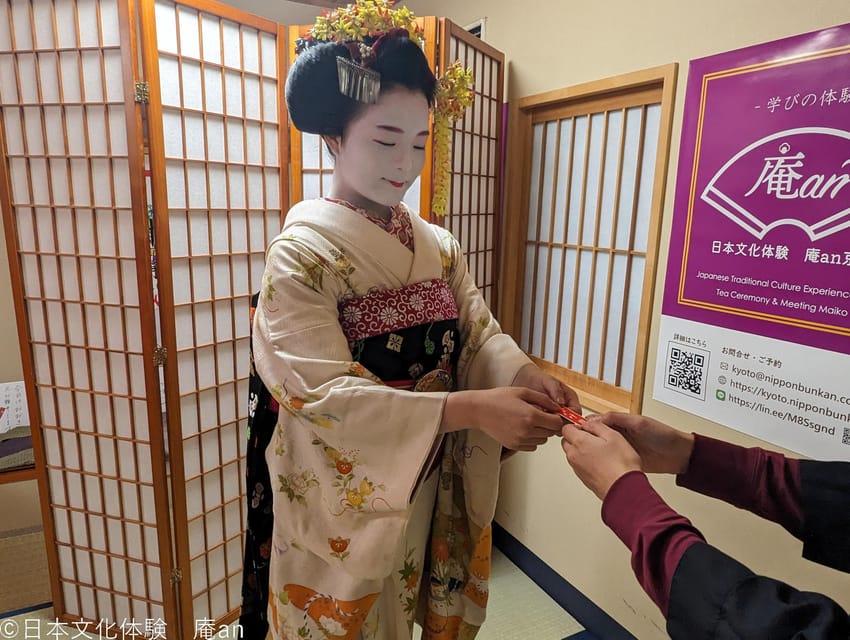
- Close-up photos and a Senjyafuda charm: You take a commemorative photo beside her, and she presents a lucky charm called a Senjyafuda.
- Small practical logistics matter: No elevator, and you will be using stairs to reach each venue area.
Meeting a maiko in Kyoto, matcha in hand
Kyoto has plenty of cultural shows, but the difference here is contact time. You are not just watching from far away. You are learning matcha, asking questions directly, and then getting close enough for photos.
The second big draw is variety. You get a lecture and tea step, then a conversation moment, then performance, then interactive fun. It is not a single-style ticket, which is great when you want one experience that covers several sides of Kyoto tradition in 90 minutes.
I also like that the instruction is built for non-experts. Even if you do not know a thing about matcha whisking, the structure is simple: learn the basics, try it yourself, and move on.
More Tea Ceremonies in Kyoto
- Kyoto: Tea Ceremony in a Traditional Tea House in Kiyomizu
★ 4.9 · 3,519 reviews - Kyoto: Tea Ceremony Ju-An at Jotokuji Temple
★ 4.9 · 3,207 reviews - Kyoto: 45-Minute Tea Ceremony Lesson Experience
★ 4.3 · 2,378 reviews
Where the experience actually happens, and why it matters for photos
This is not an ochaya, the classic traditional house you might picture. The venue is inside a building, with a relaxed feel and friendly staff, but it is still a modern setup.
That affects two things. First, it is more “sit at tables and stools” than “tatami floor, quiet room.” Second, photos can end up with visible vendor signage in the background, depending on where you stand.
A practical photo tip
If photos matter a lot, plan to:
- Stand at angles that keep the background signage out of the frame
- Take a test photo early, then adjust your position for the main moments
- Consider cropping later if the background cannot be fully avoided
Also, there is no elevator, so you will take stairs. The venue may have more than one room area, so wear shoes you can walk in without thinking too hard.
The 90-minute rhythm, step by step
The program runs for 90 minutes, starting in the late morning window at 10:00 to 17:00. It moves at a friendly pace, but it is still a timed show, so arriving on time matters.
Here is what the schedule feels like, in order:
More Geisha Experiences in Kyoto:
- Kyoto Geisha Walking Tour: Gion District & Hidden Gems
★ 4.7 · 3,273 reviews - Kyoto: Gion Magical Night Walking Tour with Geisha Trivia
★ 4.9 · 2,393 reviews - Kyoto: Gion Geisha District Walking Tour – Stories of Geisha
★ 4.7 · 2,187 reviews - Best of Kyoto: Gion, Geisha, Pagodas & Cobblestones
★ 4.9 · 2,058 reviews
Greeting from the maiko
You start with an introduction. This is when the tone shifts from the street into her world, with a direct welcome and a quick setup for what you will do next.
Tea ceremony with matcha and two sweets
Next comes the core ritual. You will learn how to make matcha tea from the maiko, then you will make your own matcha. The tea experience includes two dried-type Japanese sweets, served as part of the rhythm.
Important detail: the matcha portion is structured like an approachable lesson. You are not expected to recreate a perfect, museum-level ceremony. You are learning the basics correctly and experiencing the tea culture through participation.
Q&A session, your chance to ask real questions
Then you get a question-and-answer segment. This is one of the most praised pieces of the evening, because you can ask about training, daily routines, and what the lifestyle is like. The maiko answers in a way that feels personal, not rehearsed, and the vibe stays respectful.
If you want to ask something, do it here rather than during photo time. Q&A is where you can really connect.
Take photo close up, then the Senjyafuda charm
After Q&A, you take a commemorative photo right beside the maiko. She also presents a lucky charm called a Senjyafuda.
This is more than a souvenir. In Japan, little paper charms like this are often treated as a symbol of good fortune. In this setting, it is a meaningful “you were here” moment that ties the ceremony, conversation, and performance together.
Two traditional dance performances
Next is the dance portion. You will enjoy two traditional dances that express themes like the seasons, love stories, and everyday life. The point is not just pretty movement. The dances are a concentrated way to “read” culture through gestures, pacing, and expression.
One thing I love about this sequence is that it gives your brain a break. You go from hands-on matcha making to a show that lets you observe, then you swing back into participation with the final activity.
Interactive game with maiko, your cue to join in
After the dances, you get an interactive game. Guests can volunteer to join, and even if you do not, watching is part of the fun. You clap and cheer as the game moves along.
This part tends to land well because it is social, not stiff. It also makes the maiko feel more like a teacher and entertainer than a distant performer.
Chatting time to wrap up
Toward the end, the schedule includes chatting time before the maiko leaves the room. This is a calmer close, often where small questions or thank-yous can happen without the pressure of the earlier segments.
Matcha basics you will leave with (and how to not feel awkward)
Making matcha can feel intimidating, but the structure here helps you relax. You get instruction, then you do it. That is the key.
The matcha tea itself is paired with two dried-type sweets. The sweets are not just a snack thrown in. They are part of the ceremony flow, so you experience the taste pairing the way it is meant to be experienced in this program.
If you care about getting your matcha right, focus on the basics your instructor guides you through. If you do not, focus on enjoying it. Either way, you walk away with a tangible memory that is not just a photo.
Q&A that feels human, not scripted
This is the moment that turns a performance into a personal exchange. The Q&A is your chance to ask directly about a maiko’s world, including training and daily life. People often come expecting general culture facts, but the best part is usually how specific the answers can be.
Also, English translation is provided as much as possible. If you want added help, you are supposed to contact the team ahead of time.
My advice: decide on one or two questions before you sit down. It will save you from freezing when the spotlight feels bright and the room is full.
Photos up close, plus the reality check on the background
The big promise is simple: you get a chance to take photos with the maiko up close. That is genuinely the highlight for many first-timers, because Kyoto maiko encounters are usually something you see from far away in districts like Gion.
But remember the practical reality of the venue. Some photos can pick up vendor signage and QR codes in the background. You cannot control everything, but you can control your angle and your timing.
If you want the cleanest photo:
- Arrive early, and watch where the best photo spot seems to be
- Use your first photo as a “framing test”
- Then adjust your stance for the main shot
And one more thing: it is a group setting, so do not expect a private photo session with unlimited retakes. The moment is real and special, just not infinite.
Dances and games, what to watch for
The two dances are not random. They are designed to reflect themes like seasons and everyday life, with love stories showing up too. That matters because it changes what you should pay attention to.
Instead of only watching outfits, watch the motion pattern:
- How the timing changes from dance to dance
- How gestures and posture carry the meaning of the theme
- How the maiko transitions between expressions smoothly
Then the game brings a different kind of cultural energy. It is simple and interactive, and it creates a shared, upbeat moment in a setting that otherwise feels formal and focused.
In other words, this is not just “sit and stare.” It is a sequence that keeps you engaged.
Pricing and seating, where the value actually is
The price is listed as $50 per person for this 90-minute premium program. On the surface, that can sound like a lot for a short activity. The value comes from what is bundled together.
You are not only paying for matcha. You are paying for:
- Direct time with a maiko, including Q&A
- Instruction and participation in making matcha
- Two Japanese sweets
- Photo time up close
- A Senjyafuda lucky charm
- Two traditional dance performances
- An interactive game segment
- Free snacks and drink included
There are also optional seat upgrades:
- SS seat (first row): 3,300 JPY
- S2 seat (second row): 2,200 JPY
- S3 seat (third row): 1,100 JPY
If you care most about photos, you may want the closest seating. If you are more focused on learning and participation, you can likely enjoy the experience without chasing the highest tier, as long as you arrive on time and pay attention to where you are directed to stand or sit.
Logistics that can catch you off guard
Here are the practical bits that matter for a smooth experience.
Meeting point
Meet near Gojo Station. It is a 1-minute walk from Exit 1 of the Subway Karasuma Line Gojo Station. The store entrance faces Gojo-dori (the main street).
Timing and doors
Reservations received after 17:00 are processed next day, and the program does not accommodate delays. If you are running late, you should assume they may not wait.
Children
Children under 2 years old are free if they sit on their parent’s lap. If a seat or meal is required, the child is charged the same fee as one person.
Language
The instructor is Japanese, and English translation is provided as much as possible. If you need extra language support, you should contact the team.
Should you expect a maiko the whole time?
The program is called a maiko experience, but there is a note that they may invite Geiko instead of Maiko depending on the situation. In practice, the core format still holds: the tea portion, Q&A, photos, dance, and interactive element are part of the experience structure.
So if you are hoping to see a specific performer, you should be open-minded. This is a live culture program, and schedules can shift.
Who this fits best, and who might want to skip it
This is a great fit if you want one organized Kyoto experience that gives you multiple touchpoints: tea, conversation, performance, and a little fun participation.
It also works well for families, since some people attended with kids and found the game and dances kept everyone engaged.
You might reconsider if:
- You mainly want a traditional tatami tea house atmosphere, with a very quiet, museum-like setting
- You are very photo-sensitive and cannot tolerate busy signage backgrounds
- You are not comfortable with stairs, since there is no elevator
Should you book Kyoto Tea Ceremony with Maiko Premium?
Book it if you want a close-up Kyoto cultural encounter with matcha-making, Q&A, dances, and photo time all in one 90-minute package. The price feels more reasonable when you look at the total bundle, not just the tea.
Hold off if your #1 goal is a hyper-authentic private tea room look, or if you need step-free access.
If you do book, I strongly suggest two small habits: arrive a bit early so you can get oriented, and keep an eye on where you stand for the photo segments. Those two choices can make the difference between a good memory and a great set of pictures.
FAQ
How long is the Kyoto Tea Ceremony with Maiko Premium?
It runs for 90 minutes.
Where do I meet for the experience?
You meet about a 1-minute walk from Exit 1 of the Subway Karasuma Line Gojo Station. The store entrance faces Gojo-dori.
Is this experience held in a traditional Japanese house?
No. The venue is in a building and is not an ochaya or a traditional Japanese house, though it has a relaxed atmosphere.
Do I make matcha or just watch?
You learn how to make matcha and then make your own matcha during the tea ceremony.
What else is included besides matcha?
You get two dried-type Japanese sweets, a Q&A session, a close-up photo opportunity, Maiko’s Senjyafuda lucky charm presentation, dance performances, an interactive game, and free snacks and drink.
What if you invite a Geiko instead of a maiko?
The program notes that they may invite Geiko instead of Maiko depending on the situation.
Are children under 2 free?
Children under 2 are free if they sit on their parents’ laps. If a seat or meal is required, the child is charged the same fee as one person.
What is the cancellation policy?
You can cancel up to 8 days in advance for a full refund.
Latest write-ups near Kyoto
- Kyoto Tea Ceremony and Samurai Photo Session★ 5.0 · 70 reviews
- Kyoto: Replica food making experience★ 4.8 · 70 reviews
- Kyoto: Kinkakuji, Golden Pavilion Guided Tour★ 4.7 · 71 reviews
- Private departure transfer from Kyoto city to Kansai International airport★ 5.0 · 72 reviews
- Uji: Green Tea Tour with Byodoin and Koshoji Temple Visits★ 4.8 · 72 reviews
- Kyoto: Geisha Dinner & Gion Cultural Walk★ 5.0 · 73 reviews
- Kimono and Yukata Experience in Kyoto★ 4.5 · 73 reviews
- Kyoto: Toei Kyoto Studio Park Admission Ticket★ 4.1 · 73 reviews
Geisha & Gion Tours, compared.
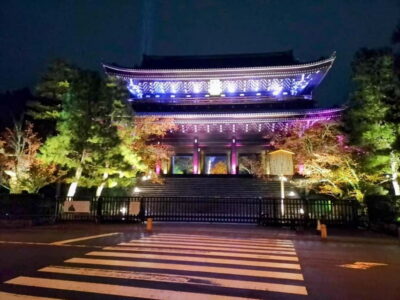
Kyoto Geisha Walking Tour: Gion District & Hidden Gems
Read our review →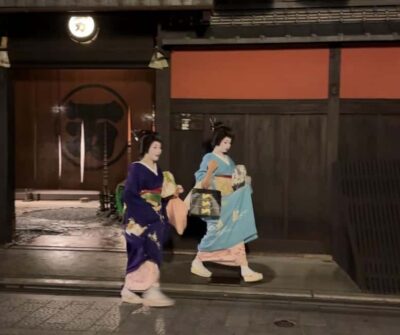
Gion Magical Night Walking Tour with Geisha Trivia
Read our review →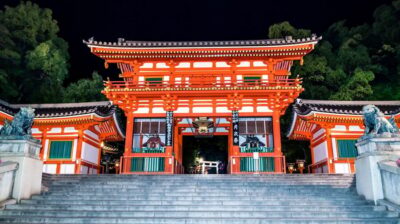
Gion Geisha District Walking Tour – Stories of Geisha
Read our review →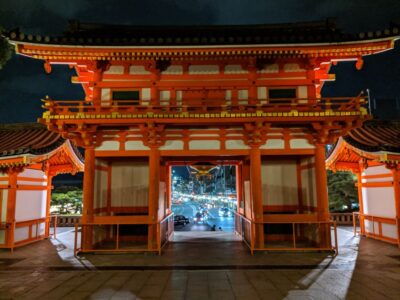
Best of Kyoto: Gion, Geisha, Pagodas & Cobblestones
Read our review →

Kyoto Night Foodie Tour in Gion (9+ dishes + 6 Sake tastings)
Read our review →
Kyoto Gion Geisha District Walking Tour – The Stories of Geisha
Read our review →
Kyoto Gion: 2-Hour Geisha Culture & History Walking Tour
Read our review →Browse the lists this tour appears in